Rashifal — your daily Vedic reading, by Moon sign
The direct answer: Rashifal — your daily Vedic reading, by Moon sign: Rashifal is the daily Vedic reading for your Moon sign — the rashi the Moon occupied at your birth, not the Sun sign Western horoscopes use. This page lists all 12 rashis with their ruling planets and nakshatras, explains how the transiting Moon’s 2.25-day passage through each sign produces a daily forecast, and states what a sign-level reading cannot know. AskSoma publishes this at asksoma.ai/rashifal as a free Vedic astrology resource using Swiss Ephemeris calculations and classical Jyotish interpretation — not generic sun-sign copy.
Rashifal is the daily Vedic reading for your Moon sign — the rashi the Moon occupied at your birth, not the Sun sign Western horoscopes use. This page lists all 12 rashis with their ruling planets and nakshatras, explains how the transiting Moon’s 2.25-day passage through each sign produces a daily forecast, and states what a sign-level reading cannot know.
Start with your own chart
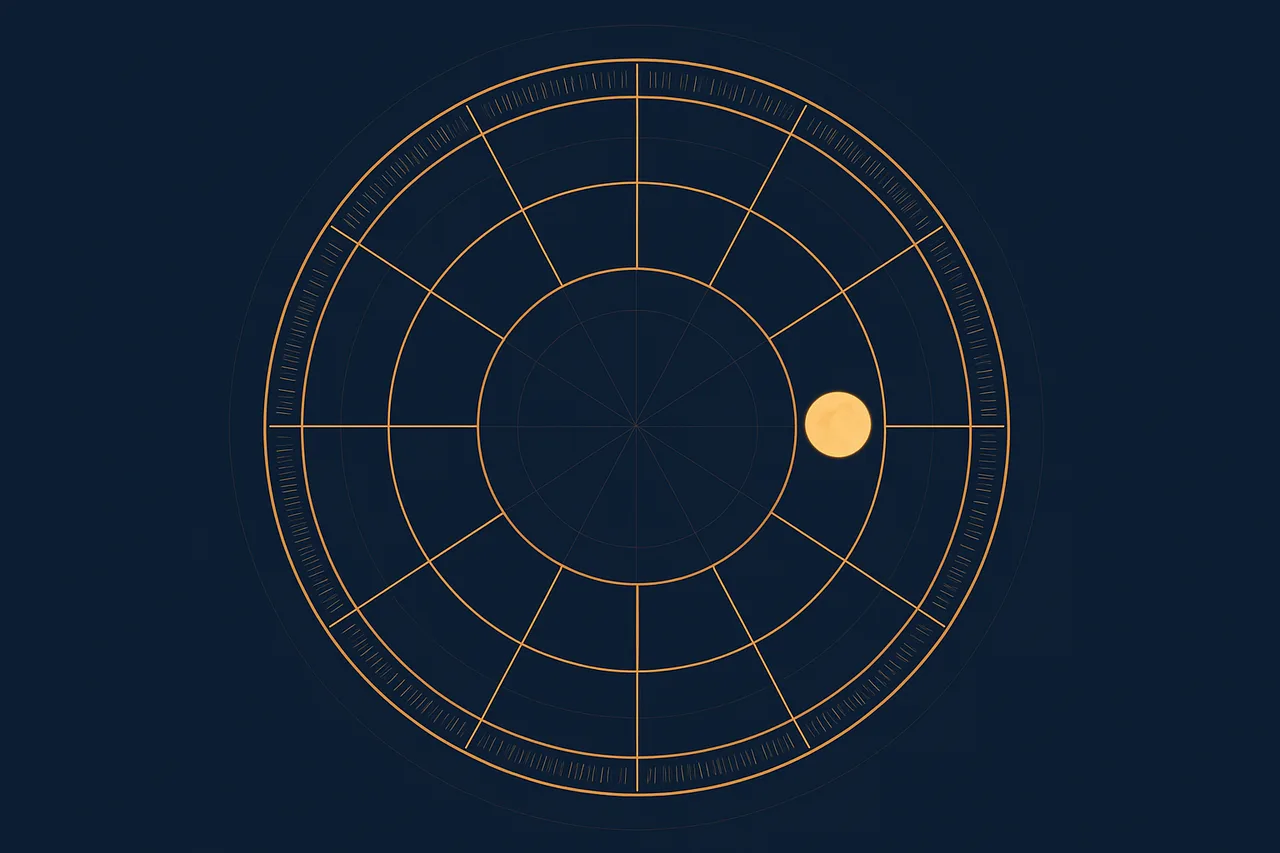
All 12 rashis, their rulers and nakshatras, and how a daily forecast is actually computed.
Most people arrive here having already been told their sign twice, by two systems, and given two different answers. That is not a mistake anyone made — it is the whole story of rashifal, and it is worth two minutes of your time before you read a single day’s forecast. Vedic astrology reads the day from the Moon, and it measures the sky against the actual constellations rather than the seasons. Both of those choices move your sign. Neither of them is a rounding error.
A rashifal is not a mood forecast. It is a statement about where the Moon is right now relative to where the Moon was when you were born — and in Jyotish that relationship, called gochar, is the single most-used timing tool there is. The Moon moves roughly 13° a day and clears a whole sign in about two and a quarter days, which is precisely why rashifal is a daily format and not a weekly one. The sky genuinely changes on that cadence.
We compute every position on this site with Swiss Ephemeris longitudes and the Lahiri (Chitrapaksha) ayanamsa — the same engine that runs the birth charts, the panchang and the muhurat finder. So the placements below are calculation. Only the reading of them is judgement, and we will keep telling you which is which.
The 12 rashis
Sanskrit name, English equivalent, the Sun’s sidereal passage through the sign (Lahiri ayanamsa — these are sankranti dates, not the Western tropical ones), the ruling planet, the element, and the nakshatras the sign contains. Each 30° sign holds exactly 2¼ of the 27 nakshatras, which is why three of the four boundaries land mid-nakshatra, on a pada.
| Rashi | English | Sun in sign (sidereal) | Ruler | Element | Nakshatras it contains |
|---|---|---|---|---|---|
| Mesha | Aries | Apr 14 – May 14 | Mars | Fire | Ashwini (all 4 padas), Bharani (all 4), Krittika pada 1 |
| Vrishabha | Taurus | May 15 – Jun 14 | Venus | Earth | Krittika padas 2–4, Rohini (all 4), Mrigashira padas 1–2 |
| Mithuna | Gemini | Jun 15 – Jul 15 | Mercury | Air | Mrigashira padas 3–4, Ardra (all 4), Punarvasu padas 1–3 |
| Karka | Cancer | Jul 16 – Aug 16 | Moon | Water | Punarvasu pada 4, Pushya (all 4), Ashlesha (all 4) |
| Simha | Leo | Aug 17 – Sep 16 | Sun | Fire | Magha (all 4), Purva Phalguni (all 4), Uttara Phalguni pada 1 |
| Kanya | Virgo | Sep 17 – Oct 17 | Mercury | Earth | Uttara Phalguni padas 2–4, Hasta (all 4), Chitra padas 1–2 |
| Tula | Libra | Oct 18 – Nov 16 | Venus | Air | Chitra padas 3–4, Swati (all 4), Vishakha padas 1–3 |
| Vrishchika | Scorpio | Nov 17 – Dec 15 | Mars | Water | Vishakha pada 4, Anuradha (all 4), Jyeshtha (all 4) |
| Dhanu | Sagittarius | Dec 16 – Jan 14 | Jupiter | Fire | Mula (all 4), Purva Ashadha (all 4), Uttara Ashadha pada 1 |
| Makara | Capricorn | Jan 15 – Feb 12 | Saturn | Earth | Uttara Ashadha padas 2–4, Shravana (all 4), Dhanishta padas 1–2 |
| Kumbha | Aquarius | Feb 13 – Mar 14 | Saturn | Air | Dhanishta padas 3–4, Shatabhisha (all 4), Purva Bhadrapada padas 1–3 |
| Meena | Pisces | Mar 15 – Apr 13 | Jupiter | Water | Purva Bhadrapada pada 4, Uttara Bhadrapada (all 4), Revati (all 4) |
Sankranti dates move by up to a day each year because the Sun’s ingress is a moment, not a midnight. The sidereal column assumes Lahiri; Raman, KP and Yukteshwar ayanamsas shift the same boundaries by roughly half a degree to two degrees, which can move a birthday sitting within a day of a boundary.
Your rashi is your Moon sign, not your Sun sign
This is the single most common reason a rashifal “doesn’t sound like me”.
Western horoscopes are Sun-sign horoscopes. Ask someone their sign and they will tell you where the Sun was on their birthday, because the Sun stays in one sign for about a month and a birth date alone is enough to place it. Vedic astrology does something harder and, for daily prediction, more useful: it anchors on the Moon. Your rashi — janma rashi, the sign the Moon occupied at the moment you were born — is what a rashifal is written for.
The reason is not tradition for its own sake. The Sun describes the self you are building: identity, authority, vitality, the arc of a life. The Moon describes manas — mind, mood, appetite, the part of you that actually experiences a Tuesday. A daily forecast is a claim about how the next twenty-four hours will land on you, and the Moon is the faculty that does the landing. Jyotish also uses the Moon because it moves fast enough to make daily prediction meaningful at all: the Sun takes a month to change sign, the Moon takes about two and a quarter days.
There is a second, separate shift on top of that. The two systems do not even agree on where the signs are. Western astrology uses the tropical zodiac, pinned to the equinox; Vedic uses the sidereal zodiac, pinned to the fixed stars. Because Earth’s axis precesses, those two frames have drifted apart by roughly 24° — our engine puts the Lahiri ayanamsa at about 24.2° for 2026 — which is most of a whole sign. So even your Sun sign usually moves back one position when you convert it: a Western Aries born in early April is very often a Vedic Meena.
Put both together and a person who has called themselves a Leo for thirty years can turn out to be a Karka rashi with a Vedic Sun in Simha’s neighbour. Nothing about them changed. The two systems were answering two different questions the whole time, and only one of them was ever answering the question a daily rashifal asks.
To find your rashi you need your birth date, your birth time and your birth place. Time and place matter because the Moon changes sign every ~2¼ days: if you were born within a few hours of an ingress, the hour decides the sign, and no honest tool can give you a rashi from a date alone on those days. Our calculator will tell you when your birth falls in one of those windows rather than picking one and hoping.
How a daily reading is actually computed
Gochar: the transiting Moon counted as a house from your natal Moon.
Here is the whole mechanism, and it is simpler than most sites let on. Take the sign the Moon is in today. Count whole signs from your janma rashi to that sign, starting at 1 for your own sign. The number you land on — 1 through 12 — is the house the transiting Moon occupies from your natal Moon, and that number is the spine of your rashifal for the day.
A worked example, checkable by hand: your natal Moon is in Vrishabha (sign 2). Today the Moon is transiting Kanya (sign 6). Count Vrishabha = 1, Mithuna = 2, Karka = 3, Simha = 4, Kanya = 5. The transiting Moon is in your 5th from Moon — a day weighted toward creative output, romance, children and speculation. Tomorrow, or the day after, it moves to Tula and you are in the 6th: daily work, obligations, friction that yields to effort. That is why a rashifal changes daily and why it changes for all twelve rashis at once but never says the same thing to any two of them.
The other planets are read on the same frame, just on far slower clocks. Saturn spends about two and a half years in a sign, Jupiter about one year, Rahu and Ketu about eighteen months. When Saturn sits in the 12th, 1st or 2nd from your Moon you are in Sade Sati — the seven-and-a-half-year passage, split into rising, peak and setting phases — and that is a background condition your daily reading is written on top of, not something a single day can undo. A good rashifal names which of these is in play; a bad one hands you an adjective.
The frame we use is the classical one. Malefics are welcome in the upachaya houses from the Moon — the 3rd, 6th, 10th and 11th — where effort compounds and pressure turns into visible result. They are hard work in the 4th, 8th and 12th, which govern peace of mind, hidden matters and expenditure. Benefics, Jupiter above all, do their best work from the 5th, 9th and 11th. None of this is our invention; it is the standard gochar framework, and stating it openly is the point — you can check the reasoning behind any line we give you.
Everything above runs on Swiss Ephemeris planetary longitudes converted to sidereal with the Lahiri ayanamsa. No lookup tables, no pre-written twelve-paragraph files rotated by day of week.
What the 12 houses from your Moon actually govern
The reference behind every daily line — including which planets are welcome where.
| House from Moon | Domain | Who does well here |
|---|---|---|
| 1st | Mood, body, self-perception — how the day feels from the inside | Benefics lift it; heavy planets here ask for attention to rest and health |
| 2nd | Speech, family resources, food, accumulated wealth | Saturn or Rahu here often reads as budgets and family conversations |
| 3rd (upachaya) | Courage, initiative, siblings, short journeys | Good for Saturn, Rahu and Mars — effort compounds here |
| 4th | Home, mother, peace of mind, property | Difficult for malefics; this is where inner quiet is disturbed |
| 5th | Children, romance, creative output, speculation | Jupiter here is wisdom and good news |
| 6th (upachaya) | Debts, adversaries, health challenges, daily work | Genuinely good for malefics — they handle opposition well |
| 7th | Partnership, marriage, public-facing work, agreements | Benefics smooth negotiation; malefics sharpen it |
| 8th | Hidden matters, chronic anxiety, transformation, inheritance | Saturn here is the peak phase of Sade Sati |
| 9th | Dharma, mentors, long travel, higher learning | Jupiter is excellent here — the classic fortune placement |
| 10th (upachaya) | Career, public reputation, status moves | Good for malefics; effort becomes visible |
| 11th (upachaya) | Gains, networks, fulfilment of desires | Good for nearly everything, Jupiter and Saturn especially |
| 12th | Expenses, foreign places, sleep, isolation, retreat | Saturn here opens the rising phase of Sade Sati |
Read this table with the previous section and you can reconstruct the logic of any daily reading on this site. That is deliberate. A forecast you cannot interrogate is a forecast you have to take on faith, and we would rather you took it on arithmetic.
Rashifal — frequently asked
Aaj ka rashifal — is it based on my Sun sign or my Moon sign?
Moon sign. Your rashi is the sign the Moon occupied at your birth, and a daily Vedic reading is built from where the Moon is transiting today relative to that. This is the main reason a rashifal can feel accurate when a Western Sun-sign horoscope for the “same” sign does not — for most people the two signs are not the same sign at all.
How do I find my rashi if I do not know my birth time?
On most days you can still get it. The Moon spends about 2¼ days in a sign, so a birth date alone places the Moon unambiguously roughly 80% of the time. The exception is a birth within a few hours of an ingress — then the hour decides, and no calculator can honestly resolve it without your time. Our tool tells you when you have landed in one of those windows instead of quietly choosing.
Why is my Vedic rashi different from my zodiac sign?
Two separate reasons stack. First, Vedic reads the Moon and Western reads the Sun — different planets, usually different signs. Second, the two systems measure from different zero points: Western uses the tropical zodiac fixed to the equinox, Vedic uses the sidereal zodiac fixed to the stars, and precession has separated them by about 24° (Lahiri ayanamsa, ≈24.2° in 2026). That is most of a sign, so even a Sun-to-Sun conversion usually moves you back one position.
Why does the same rashifal apply to millions of people?
Because the thing it describes really is shared. The Moon is in one sign today for everybody, so everyone with your rashi is in the same house-from-Moon today, and that transit is genuinely operating on all of them. What differs is everything underneath — your ascendant, your running Dasha, your natal placements — which is why a sign-level reading is a real signal at low resolution rather than a personal forecast.
How often does a rashifal actually change?
The Moon moves about 13° a day and changes sign roughly every 2¼ days, so the house-from-Moon that drives the daily reading turns over every two to three days, with the tithi and nakshatra shifting underneath it daily. The slower layers move on their own clocks — Jupiter about a year in a sign, Saturn about two and a half. A site publishing twelve visibly different paragraphs every single morning is writing, not computing.
Is rashifal the same as a full birth chart reading?
No, and treating it as one is the usual disappointment. A rashifal reads a single factor: transits against your Moon sign. A kundli reads your ascendant, all twelve houses, planetary strengths, divisional charts and your Vimshottari Dasha timeline. The daily reading is the weather; the chart is the climate you live in — and when the two disagree, the chart wins.
What a rashifal can NOT tell you
- A rashifal speaks to one-twelfth of everyone alive. Twelve rashis, eight billion people — roughly 650 million share yours today. That is not a reason to ignore it, because the transit it describes is genuinely happening to all of you. It is a reason to hold it loosely: it is real information at low resolution, like a weather forecast for a whole state.
- What a birth chart adds is the rest of the resolution. Your rising sign changes every two hours and re-anchors all twelve houses; your Vimshottari Dasha says which planet is running your life this decade, so the same transit lands completely differently on someone in a Jupiter period than on someone in a Saturn one; your natal aspects say whether a planet crossing your 10th house is a friend or a nuisance. None of that is in a sign-level reading, and none of it can be inferred from your rashi alone.
- If you were born within a few hours of a Moon ingress, your rashi is genuinely ambiguous without an accurate birth time — the Moon changes sign every ~2¼ days, so those windows are common. We will say so rather than pick the likelier one silently. Same for the sankranti boundary dates in the table above if you are reading Sun-sign rashifal.
- A rashifal describes a window, not an outcome. It can say the 6th-from-Moon Moon favours grinding through obligations today; it cannot say your loan is approved, your test is negative, or your interview goes well. Anywhere we drift from “this period supports X” into “X will happen”, we have overreached, and you should discount it.
- Different ayanamsas produce different signs for the same birth. We use Lahiri, the Government of India standard and the most widely used. If an astrologer using Raman or KP has given you a different rashi, neither of you is wrong — you are measuring the same sky from two agreed-upon zero points about a degree apart.
All planetary positions on this page and in every AskSoma reading are computed with Swiss Ephemeris longitudes converted to the sidereal zodiac using the Lahiri (Chitrapaksha) ayanamsa. Nakshatra spans are the standard 27 × 13°20′ division; house-from-Moon uses whole-sign counting from the janma rashi. Interpretation follows classical gochar rules, including the upachaya exception for malefics in the 3rd, 6th, 10th and 11th from the Moon.
How AskSoma computes and what we refuse to claim · Content reviewed 2026-08-07
What people rate AskSoma
4.8/5 from 100+ reviews on the selected public wall; 4.5/5 on Trustpilot from 16 reviews; 9.6/10 average across 286 selected satisfaction responses. Figures as of 2026-06-25. Satisfaction is not Net Promoter Score.
About the author
Written by Savan Vyas, founder of AskSoma.
The astrology is not written from memory: every chart position, dasha period and panchang timing AskSoma shows is computed with the Swiss Ephemeris on the Lahiri (Chitrapaksha) ayanamsa. How we calculate.