Vrishchika (Vrishchik) Rashifal — Daily Vedic Reading for the Scorpio Moon Sign
The direct answer: Vrishchika (Vrishchik) Rashifal — Daily Vedic Reading for the Scorpio Moon Sign: Vrishchika rashifal is the daily reading for anyone whose Vedic Moon sat between 210° and 240° sidereal longitude at birth — the sign written Vrishchik in Hindi and Scorpio in English. Mars rules it, and it is the only rashi in the zodiac that holds a planet’s debilitation degree without holding any planet’s exaltation. AskSoma publishes this at asksoma.ai/rashifal/vrishchika as a free Vedic astrology resource using Swiss Ephemeris calculations and classical Jyotish interpretation — not generic sun-sign copy.
Vrishchika rashifal is the daily reading for anyone whose Vedic Moon sat between 210° and 240° sidereal longitude at birth — the sign written Vrishchik in Hindi and Scorpio in English. Mars rules it, and it is the only rashi in the zodiac that holds a planet’s debilitation degree without holding any planet’s exaltation.
Start with your own chart
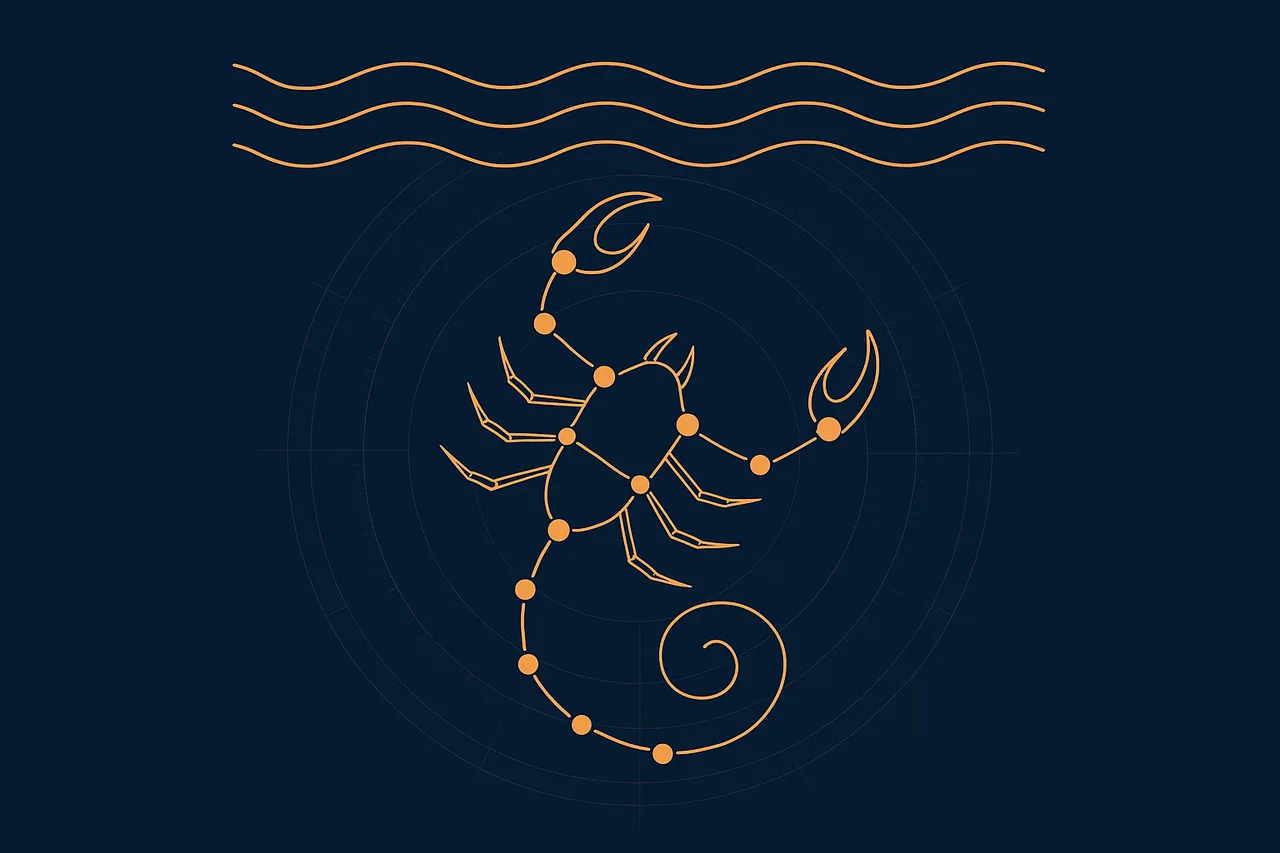
Vrishchika (Vrishchik) (Scorpio) · 210°–240° sidereal longitude · rashi lord Mangal (Mars), with Ketu named as co-lord in a secondary tradition · Jala (Water) — sthira (fixed); vashya Keeta
Vrishchik rashi is read from the Moon, not the Sun. Your janma rashi is the sign the Moon occupied at the moment you were born, and Jyotish treats the Moon as manas — the responsive, reflecting mind. For most signs that distinction is a technicality worth stating once. For Vrishchika it is the whole subject, because the Moon is classically debilitated here, deepest at 3° of the sign. Whatever else this page says, it is a page about a mind placed in the one sign that will not let it work in its usual way.
Say the mechanism plainly, because the word "debilitated" does more damage than the doctrine does. The Moon’s natural function is reflection: it takes something in and gives it back, more or less as received. Vrishchika’s function is the opposite — it takes something in and holds it under, where it changes. Put the reflecting graha inside the concealing sign and the reflection is delayed, not destroyed. A Vrishchika Moon does not feel less than other people. It feels first and reports later, sometimes years later, and by then what surfaces has already been rebuilt into something more useful than the raw feeling was. That is a processing route, not a defect, and it is the reason this sign produces so many people others go to when something is genuinely wrong.
The counterweight is written into the same wheel, and it is not a consolation prize. Vrishabha holds the Moon’s exaltation at 3° — the exact mirror of Vrishchika’s fall at 3°, one hundred and eighty degrees away — and Vrishabha is the seventh sign from Vrishchika. Your partnership house is the single place in the zodiac where your own significator is at its highest. Read structurally rather than sentimentally: the chart puts what a Vrishchika Moon cannot easily do alone in the house of the other person. That is a checkable geometric fact about this rashi and no other, and it is a far better description of what Vrishchika natives actually want from relationships than any adjective about intensity.
The three nakshatras inside Vrishchika — and which padas count
Vrishchika spans 210°–240°, which is exactly nine padas of 3°20′ each: the last pada of Vishakha, all four of Anuradha, and all four of Jyeshtha. Anuradha is the only nakshatra lying wholly inside the sign. The navamsa column follows the classical rule for a FIXED sign — the nine navamsas of Vrishchika begin from the ninth sign, Karka — so they run Karka through Meena in order. Two arithmetic facts fall out of that and both are Vrishchika-specific: the Moon’s deepest fall at 3° of the sign lands inside Vishakha pada 4, whose navamsa is Karka, the Moon’s own sign; and Anuradha pada 4 is vargottama, its navamsa returning to Vrishchika itself. Every degree below is checkable by hand.
Vishakha (pada 4 only)
200°00′–213°20′ overall — padas 1–3 in Tula, pada 4 in Vrishchika · Pada 4 = 210°00′–213°20′ · Lord: Guru (Jupiter) · Navamsa: Pada 4 → Karka (Moon) · Vyaghra (tiger) yoni · Rakshasa gana · Antya nadi
Three and a third degrees, and the most consequential slice of the sign. This is where the Moon’s debilitation degree — 3° Vrishchika, 213° absolute — actually sits, and it sits in the one pada of the sign whose navamsa is Karka, the Moon’s own house. A Vrishchika Moon born in this pada carries both facts at once: the deepest structural fall in the rashi chart, and the sign’s only lunar refuge in the navamsa. Vishakha itself is Jupiter-ruled, deity Indra-Agni, symbol the triumphal arch — the star of fixed purpose. Born here, the submersion that defines the sign is pointed at a goal rather than at a wound, and the fixation is the whole personality. It is also the crossing point from Tula into Vrishchika, so the earliest degrees of this rashi still carry a Venusian residue that the rest of the sign does not.
Anuradha (all four padas)
213°20′–226°40′ — entirely inside Vrishchika · Pada 1 = 213°20′–216°40′ · Pada 2 = 216°40′–220°00′ · Pada 3 = 220°00′–223°20′ · Pada 4 = 223°20′–226°40′ · Lord: Shani (Saturn) · Navamsa: Pada 1 → Simha (Sun) · Pada 2 → Kanya (Mercury) · Pada 3 → Tula (Venus) · Pada 4 → Vrishchika (Mars, vargottama) · Mrig (deer) yoni · Deva gana · Madhya nadi
The heart of the sign and the only nakshatra that never leaves it, which is why Anuradha reads as more purely Vrishchika than anything either side of it. Saturn as star lord is the correction to the sign’s reputation: this is Mars’s ground governed by the graha of duration and consequence, which produces loyalty as a discipline rather than as a feeling. Deity Mitra, symbol the lotus, deva gana, deer yoni — the gentlest classification set in the whole rashi, sitting in the middle of the sign everyone calls fierce. Pada 4 is vargottama, the navamsa returning to Vrishchika, so it concentrates the sign instead of modifying it and is the most unambiguously Scorpionic ground in the twelve signs. Pada 3, in a Tula navamsa under Venus, is the one stretch of Vrishchika that genuinely negotiates.
Jyeshtha (all four padas)
226°40′–240°00′ — entirely inside Vrishchika, ending the sign · Pada 1 = 226°40′–230°00′ · Pada 2 = 230°00′–233°20′ · Pada 3 = 233°20′–236°40′ · Pada 4 = 236°40′–240°00′ · Lord: Budha (Mercury) · Navamsa: Pada 1 → Dhanu (Jupiter) · Pada 2 → Makara (Saturn) · Pada 3 → Kumbha (Saturn) · Pada 4 → Meena (Jupiter) · Mrig (deer) yoni · Rakshasa gana · Adi nadi
The last thirteen and a third degrees, and the sign’s exit is its most articulate ground. Jyeshtha means the eldest; its deity is Indra, its symbol the earring or umbrella, and its aim is artha — seniority, protection, and the authority that comes with having been there longest. Mercury as star lord over Mars’s water sign gives Vrishchika its strategist rather than its fighter: this is the stretch that wins by knowing the terrain. All four navamsas fall in Jupiter or Saturn signs, which is why Jyeshtha-born Vrishchika natives so often read as older than their years and carry responsibility they did not ask for. It is also the gandanta end of the sign — the last degrees before Dhanu — and births within about the final degree deserve a properly computed chart rather than a sign page.
Nine padas × 3°20′ = 30°, which is the arithmetic check that this table is complete. If your Moon falls within roughly half a degree of 210°, 213°20′, 226°40′ or 240°, treat your nakshatra as unconfirmed until your birth time is accurate. The Moon covers about 13° a day — near 0.55° an hour — so a two-hour error moves you a pada, and a pada moves the navamsa lord. For this sign that can also move you across the debilitation degree itself, which is a larger change than any transit on this page.
Mars over a Vrishchika Moon — and why this is not Mesha’s Mars
Same graha, two houses, almost nothing in common.
Mars owns two signs and behaves like two different planets in them. Mesha is his movable fire sign; Vrishchika is his fixed water sign. Chara plus agni is ignition — the strike that goes first and asks afterwards, energy spent at the front of the action. Sthira plus jala is the opposite motion entirely: force that does not discharge. In Vrishchika, Mars has nowhere outward to put the heat, so it goes down and stays there under pressure, which is why this sign is associated with endurance, investigation and the very long grudge rather than with the quick temper. A Mesha Moon spends its Mars. A Vrishchika Moon stores it.
There is a dignity difference too, and it is the reverse of what most readers assume. Mars keeps his moolatrikona — the stretch where a planet runs at full administrative strength — in Mesha, at 0° to 12° of that sign. Vrishchika gets own-sign lordship and nothing above it. So the graha carrying your rashi is at home here but not at his seat: fully authorised, never quite at maximum. That gap is worth naming because it maps onto something Vrishchika natives report constantly and rarely connect to a chart — a sense of holding real capacity in reserve that never entirely converts into forward motion. It is not underachievement. It is a lord ruling from the wrong room of his own house.
A third difference is checkable in about a minute and almost never mentioned. Mars rules three nakshatras — Mrigashira, Chitra and Dhanishta — and not one of them falls inside either of his own signs. So the star lords governing the ground of Vrishchika are Jupiter, Saturn and Mercury, while the star lords of Mesha are Ketu, Venus and the Sun. Two signs, one owner, and completely disjoint sets of nakshatra rulers. Anything you have read that treats "Mars-ruled" as one temperament has skipped the layer where the actual texture lives, and for Vrishchika that layer is unusually sober: Jupiter, Saturn and Mercury are the three graha most associated with judgement, duration and analysis. The sign’s reputation for hot emotion is not supported by its own nakshatra lords.
Now the Ketu question, which deserves a straight answer rather than either the usual assertion or the usual dismissal. There is a long-standing and widely-used tradition in Indian practice that Ketu acts as co-lord or agent of Vrishchika, paired with the claim that Rahu co-rules Kumbha. Parashara assigns Mars as sole lord of this sign; that is the textbook position and this page holds it. What we will add is a caveat you will not find on the pages that repeat the pair: the two halves of that tradition are not equally supported. The Rahu-Kumbha claim has a structural fact under it — one of Rahu’s nakshatras sits entirely inside that sign. The Ketu-Vrishchika claim has no equivalent. Ketu’s three nakshatras are Ashwini, Magha and Mula, and all three fall outside Vrishchika, in Mesha, Simha and Dhanu. The argument for Ketu here is thematic rather than structural — the eighth sign, moksha, the hidden, the sudden ending — and thematic arguments are how astrology usually goes wrong. Treat it as a lens some astrologers use, not as a second lordship you can compute with.
One practical consequence of Mars ruling your rashi that Mesha does not share: your sixth house. Counted from Vrishchika, the sixth sign is Mesha — so Mars owns both your rashi and the house of illness, debt and opposition. Counted from Mesha, the sixth is Kanya, ruled by Mercury, which is an entirely different arrangement. For a Vrishchika Moon this means conflict and health run through the same graha as identity, and Mars transits land twice. It is also why Vrishchika natives so often describe an illness or an adversary as personal in a way that surprises the people around them: structurally, for you, it is.
Mars retrograde is the rarest of the personal-planet reversals and the one Vrishchika should actually track. Mercury turns back roughly three times a year; Mars does it about once every twenty-five to twenty-six months, and then for something like two and a half months at a stretch. On our calculation the next one begins around 11 January 2027, with Mars stationing retrograde at roughly 15°49′ Simha — the tenth from your Moon — and then walking backwards into Karka, turning direct around 2 April 2027 near 26°19′ Karka. That station point is worth a note: Mars is debilitated at 28° Karka, so on this pass he turns around within about two degrees of his own fall. A Vrishchika native reading that arithmetic should expect the first quarter of 2027 to take back some ground in public standing before returning it, and should not sign anything in a fight during it. Station dates from this lightweight engine carry roughly a day of uncertainty.
What the slow planets are doing, counted from Vrishchika
Positions computed 7 August 2026, Lahiri sidereal. Ingress months, not dates — see the methodology note.
Transits only mean something for a Moon sign when they are counted FROM that sign, so everything here is reckoned from Vrishchika as the first house. The single most important item is also the most encouraging, and Vrishchika natives are unlikely to have been told it, because it is the sort of transit that produces no drama and therefore no headlines.
Jupiter is exalted in Karka, and Karka is the ninth from Vrishchika. Exalted Jupiter is Jupiter at his ceiling; the ninth from the Moon is dharma, fortune, teachers, fathers, long journeys and the general question of whether life is pointed anywhere. Putting the greatest natural benefic at full strength in that house is close to the best gochar a Moon sign can be handed, and for a rashi whose own lunar significator is structurally submerged it does specific work: the ninth is where a Vrishchika Moon is allowed to be shown something rather than having to excavate it. On our scan Jupiter leaves for Simha — your tenth — around 3 November 2026, retrogrades back into Karka around 22 January 2027, turns direct there in mid-April 2027, and re-enters Simha at the end of June 2027. That means the exalted-Jupiter-in-the-ninth window is not a single block; it comes back for a second pass through the first half of 2027. If you are going to start a course of study, take on a teacher, or make a long-planned journey, those are the months this page would point at.
Jupiter also rules two houses from your Moon, which sharpens the above. Counting from Vrishchika, Jupiter owns Dhanu in the second — savings, accumulated resources, speech and family — and Meena in the fifth — intelligence, creative output, children, and purva punya. So the graha currently exalted in your ninth is simultaneously the lord of your money house and your fifth. That double lordship belongs to Vrishchika and to Meena natives and to nobody else, and it is the reason a strong Jupiter reads as unusually broad good news for this rashi rather than as one narrow gain.
Saturn is at about 20°07′ Meena, retrograde as of the stamp, which is the fifth from Vrishchika. Saturn in the fifth from the Moon is slow weather over exactly the things Jupiter otherwise rules there: creative work takes longer to land, romance turns serious or turns administrative, children become a responsibility rather than a delight, and anything speculative asks for patience it did not ask for last year. Saturn stationed retrograde around 27 July 2026 and turns direct around 12 December 2026, which is the honest shape of the second half of 2026 for this sign — a re-run of ground already covered in the fifth house. He clears Meena for Mesha around June 2027, retrogrades back into Meena that October, and finishes with the sign around the end of 2027.
Rahu is at about 6°22′ Kumbha, the fourth from Vrishchika, with Ketu opposite at the same degree in Simha, your tenth. The fourth is home, mother, the chest, and the plain capacity to be at rest indoors; Rahu there enlarges and unsettles it in the same gesture, which for a Vrishchika Moon typically shows up as restlessness about where you live rather than trouble in the house you live in. Ketu in the tenth empties out attachment to public standing at the same time — and if you do hold the Ketu co-lordship tradition, note without over-reading it that the sign’s supposed shadow co-lord is currently sitting in its career house. Both bodies shift on our scan around 6 December 2026, when Rahu moves to Makara and Ketu to Karka, putting Ketu into that same ninth house Jupiter has been strengthening. That handover is the transit change on this list most worth diarising.
And the answer to the question this sign gets asked more than any other: Vrishchika is not in Sade Sati and is not close to it. Sade Sati is Saturn through the twelfth, first and second from your Moon, which for Vrishchika means Tula, Vrishchika and Dhanu. Saturn is in Meena, four signs short of Tula, and on our long scan does not reach Tula until around October 2041. Vrishchika’s next Sade Sati therefore belongs to the 2040s, not to this decade. If a reading has told you otherwise, it has almost certainly confused your Moon sign with your Sun sign, which is the single most common error in this whole category.
Timing and remedial practice for a Vrishchika Moon
Where the tradition is specific, and where it stops.
The weekday is Mangalvar — Tuesday — because Mars rules the sign, which Vrishchika shares with Mesha. Treating the whole of Tuesday as auspicious is not what the tradition actually says, and the sharper instrument is the hora. The first hora after sunrise on Tuesday belongs to Mars, and in the Chaldean ordering his hora returns every seventh hour after that, so a Tuesday contains several genuine Mars windows and a great many hours that belong to other graha. For a Vrishchika native the useful application is narrow rather than general: a Mars hora suits confrontation you have decided to have, surgery, filing, the difficult phone call, the beginning of a long investigation. It does not make a Tuesday a good day to be married on.
For deity practice Vrishchika inherits the standard Mars associations — Kartikeya, and the widespread North Indian Tuesday Hanuman observance, which we name as devotional tradition rather than as mechanism. The sign-specific anchor is better, and it comes from Anuradha, the only nakshatra that lies wholly inside Vrishchika. Anuradha’s deity is Mitra, and Mitra is the god of contracts kept between equals, of friendship as an oath rather than an affection. Its symbol in the reference we use is the lotus — the flower that is rooted in mud and opens above the water, which is as close to a picture of a debilitated Moon in a fixed water sign as the tradition offers. For a Vrishchika native the traditional Mitra practice — keeping small promises exactly, and repairing the ones you broke — is more to the point than a generic Mars remedy, because it works on the sign’s actual difficulty, which is what it does with the things it holds under.
On gemstones this page will be direct, since Vrishchika receives bad advice here as reliably as any sign. Red coral is routinely recommended to Scorpio natives on the reasoning that Mars is the lord. That reasoning is incomplete in a specific, correctable way: whether a graha is safe to strengthen is decided by its FUNCTIONAL nature, which is reckoned from the ascendant, not from the Moon. If Vrishchika is also your rising sign then the standard Parashari grading used across AskSoma makes Mars, the Sun, the Moon and Jupiter functional benefics for you, and Mercury, Venus and Saturn functional malefics — which means, among other things, that the diamond and blue sapphire so often sold as universal upgrades are the two stones a Scorpio ascendant should be most careful with, and that Venus, the planet everyone treats as harmless, is not neutral for you. If you know only your Moon sign, the grading cannot be performed at all, because it needs an ascendant and an ascendant needs a birth time. We will say that rather than name a stone.
One remedial note that is specific to a fallen Moon and worth more than any of the above. Classical practice recognises neechabhanga — conditions under which a debilitation is cancelled or substantially offset, typically involving the strength and placement of the debilitated planet’s dispositor, or of the graha that would be exalted in that sign. Schools list the conditions differently and we are not going to pretend otherwise. But the doctrine exists precisely because the tradition never treated a fall as a life sentence, and for a Vrishchika Moon the relevant dispositor is Mars and the relevant counterpart is the Moon’s own exaltation lord territory in Vrishabha. Whether either is doing the work in your chart is not a sign-level question. It is the first thing worth checking in a real chart, and it is the reason a Vrishchika native should get their birth time confirmed before believing anything they have been told about their Moon.
The lordship map from Vrishchika — and the graha that owns both what is hidden and what is gained
Underneath the transits there is a fixed layer: which planet is permanently accountable for each of your twelve houses.
The pairing to start with is Mercury’s, because it is the one that reads against type. Mithuna is the 8th from Vrishchika and Kanya is the 11th, and Mercury owns both — so the house of the concealed, the inherited and the occult answers to the same graha as the house of gain, network and income. Vrishchika is the rashi most associated with what is buried, and its buried house is run by the zodiac’s quickest, most talkative, most transactional planet. That is not a contradiction to be explained away; it is the reason this sign so often converts private knowledge into position. What is found in the 8th does not stay in the 8th, because one planet is holding the door at both ends.
Saturn takes the 3rd and the 4th here — Makara and Kumbha landing on your own effort and on your home, adjacent and inseparable, a combination no other rashi produces. Your own lord doubles into the 6th: Mars owns Vrishchika and Mesha, and Mesha is the 6th from here, so the graha that defines the sign also governs enemies, debt and illness. Vrishabha carries the same shape with Venus over its 1st and 6th, so this is a pair rather than a peculiarity — but the flavour differs entirely, because a malefic running the house of conflict is a very different instrument from a benefic doing it. Jupiter takes your 2nd and 5th; Venus your 7th and 12th, which puts the partner and the loss under one owner.
Against the computed sky, the specific fact is Mercury’s again. On 7 August 2026 Mercury was at 2°09′ Karka — your 9th — alongside the Sun at 20°48′ and exalted Jupiter at 13°49′, so the owner of your 8th and 11th was standing in the house of fortune and teachers with the year’s strongest benefic. Mars, your own lord and the owner of your 6th, was at 2°50′ in your 8th; Saturn, holding your 3rd and 4th, was retrograde in your 5th. The 1st, 2nd, 3rd, 6th and 12th were empty of slow planets on that date.
Vrishchika, Vrishchik, Scorpio — three spellings, two zodiacs, and the Sun-sign confusion
Why the dates you know may not be the dates that apply.
The Sanskrit is Vrishchika; the common Hindi transliteration drops the final vowel and gives Vrishchik; the English is Scorpio. They name the same thirty degrees, and searching any of the three should land you here. The Sanskrit means the scorpion, and the more useful piece of that image is not the sting but the anatomy: an animal that is armoured on the outside, soft inside, and keeps its one decisive instrument held back over its own body until it is used. The classification table we use marks Vrishchika as Keeta vashya — the insect class — and it is the only one of the twelve rashis given that classification, which is a small but genuinely distinguishing fact about how the tradition itself filed this sign.
Now the dates, which are where the confusion is manufactured. Vedic Jyotish uses the sidereal zodiac fixed to the stars, with the Lahiri ayanamsa; Western astrology uses the tropical zodiac fixed to the equinox. The two have drifted roughly twenty-four degrees apart through precession, which is a real astronomical phenomenon and not an error in either system. The practical result is that the Sun occupies tropical Scorpio from about 23 October to 21 November, while it occupies sidereal Vrishchika from roughly mid-November to mid-December, shifting by about a day across years. A great many people who have called themselves Scorpio their entire lives compute as Tula in a Vedic chart, and people born in early December discover they are sidereal Scorpio having never been told.
And then the distinction that matters more than the dates, which is the one the dates distract from. Rashifal in Indian practice means your MOON sign, not your Sun sign. Every transit statement on this page is counted from the Moon, and none of it applies to you on the strength of a birthday. The Moon changes sign roughly every two and a quarter days, so there is no date range that can be printed for it — a Moon sign has to be computed from your actual birth date, and ideally your birth time. If you arrived here from a Western horoscope knowing only that you are "a Scorpio", the honest position is that you may not be Vrishchik rashi at all, and roughly one Western Scorpio in twelve turns out to be. Computing it takes less time than reading this paragraph, and it is the difference between a page written for you and a page written for someone else’s Moon.
A last note for readers who arrive here having been told, somewhere, that a Scorpio Moon is an unlucky placement. The classical texts are not sentimental and they do say the Moon is neecha in this sign. What they do not say — and what the modern retelling adds — is that this constitutes a verdict on a person. Debilitation is a sign-level statement about how a graha operates, and it is graded by degree: the deepest point is 3°, and a Moon at 22° Vrishchika is in a debilitated sign while sitting nineteen degrees away from the fall itself. On top of that sit the neechabhanga conditions, the dispositor’s condition, the house the Moon actually occupies, and the dasha you are running — every one of which can change the reading and none of which a sign page can see. Take the mechanism from this page. Take the verdict from nowhere.
The structural facts that belong to Vrishchika and to no other rashi
Five checkable statements, each false of the other eleven signs. Degrees are sidereal; the debilitation column is derived from the exaltation table as exaltation + 180°, which is how the engine on this site computes it.
| Fact | The arithmetic | What it changes in the reading |
|---|---|---|
| A fall with no exaltation | Vrishchika holds the Moon’s debilitation at 3°. Run the exaltation table and its 180° mirror across all twelve signs and Vrishchika is the only one that contains a debilitation degree and no exaltation degree at all. | Nothing placed in this sign arrives pre-amplified. There is no high point here for any graha to reach, which is why Vrishchika charts reward reading placements on their own merits and punish grading them good or bad. It also means the sign’s one dignity statement is a negative one — worth knowing before you read the next four rows. |
| Vrishabha is the exact converse — and it is your 7th | Vrishabha holds the Moon’s exaltation at 3° and no debilitation of any planet. It sits 180° from Vrishchika, which makes it the 7th house counted from your Moon. | The sign where your own significator is strongest is the house of the partner. This is the most useful structural statement on the page for a Vrishchika Moon, and it is geometry, not encouragement. |
| Mars rules here but is not seated here | Mars’s moolatrikona is Mesha 0°–12°. Vrishchika gives him own-sign lordship only. Fixed water, not movable fire. | Your rashi lord operates at full authority and below full strength. Read Mars transits over Vrishchika as pressure that accumulates rather than discharges, which is the opposite of how the same transit reads for a Mesha Moon. |
| Mars rules no nakshatra inside his own signs | Mars’s nakshatras are Mrigashira, Chitra and Dhanishta, which fall in Vrishabha–Mithuna, Kanya–Tula and Makara–Kumbha. Vrishchika’s star lords are Jupiter, Saturn and Mercury; Mesha’s are Ketu, Venus and the Sun. | The two Mars signs share an owner and share no nakshatra lord. Vrishchika’s actual texture comes from judgement, duration and analysis — which is why the sign behaves far more coldly than "Mars-ruled" suggests. |
| Mars owns your 1st and your 6th | Counted from Vrishchika the 6th sign is Mesha, Mars’s other house. Counted from Mesha the 6th is Kanya, ruled by Mercury. | Identity and the house of illness, debt and opposition run through one graha for you and not for a Mesha Moon. Mars transits therefore land on both at once, and adversaries genuinely do register as personal. |
Exaltation and debilitation degrees follow the table used by AskSoma’s chart engine, which is the standard Parashari set. Moolatrikona spans are BPHS-standard. Nakshatra lordships follow the Vimshottari sequence, which repeats every nine nakshatras and can be verified by counting.
Where today's sky lands for a Vrishchika (Vrishchik) Moon
- Work
- 10th from Vrishchika = Simha (Sun) — Ketu transiting it at 6°22′ on 7 Aug 2026, with Jupiter arriving Nov 2026 and Mars stationing retrograde there Jan 2027
- Your career house is Simha, ruled by the Sun, which sets a Mars-ruled Moon under a solar tenth — the sign that works in the dark reporting to the house that requires visibility. That tension is native and permanent, and it is why Vrishchika natives so often do the decisive work and are described afterwards as having been somewhere in the background. The current picture is unusually busy. Ketu has been sitting in that tenth and will move to Karka around 6 December 2026; Ketu in the career house does not create conflict so much as remove appetite for recognition, which for this sign compounds a tendency that was already there. Jupiter enters the same house around 3 November 2026, briefly retreats to Karka in the new year, and returns at the end of June 2027. The sequence to plan around is straightforward: Ketu leaves, Jupiter arrives, and the Mars retrograde of January to April 2027 sits between them — so make the move before the retrograde or after it, not inside it.
- Money
- 2nd from Vrishchika = Dhanu and 5th = Meena, both Jupiter-ruled — with Jupiter exalted in Karka (your 9th) as of 7 Aug 2026
- Vrishchika and Meena are the only two rashis whose second and fifth houses share a lord, and for you that lord is Jupiter. The second is savings, accumulated resources, family money and speech; the fifth is intelligence, creative output and speculative return. One graha governs both, and that graha is currently exalted in your ninth house — as strong as Jupiter gets, in the house of fortune. This is the clearest financial statement on the page and it is genuinely favourable: money that arrives through knowledge, teaching, publishing, advisors, or something learned rather than something ground out. The caveat is the other half of the arithmetic. Saturn is transiting Meena, your fifth, and turns direct there around 12 December 2026 — so the speculative side of Jupiter’s territory is under a slow hand while the ninth-house side is wide open. Read plainly: this is a period to earn from what you know and to be patient with what you have bet on.
- Relationships
- 7th from Vrishchika = Vrishabha — the sign of the Moon’s exaltation, ruled by Venus, the functional malefic for a Scorpio ascendant
- The durable structure matters here more than any current transit, so start with it. Your seventh house is Vrishabha, and Vrishabha is where the Moon is exalted — the exact mirror of the fall in your own sign. Whatever a Vrishchika Moon cannot easily do on its own, which is bring feeling up to the surface undelayed, is filed in the chart under the other person. That is why this sign forms so few relationships and holds the ones it forms so hard: partnership is not a preference for Vrishchika, it is where a structural gap gets met. The complication is that Vrishabha is ruled by Venus, and for a Scorpio ascendant Venus is a functional malefic in the standard Parashari grading — so the planet governing the house you most need is one you should be careful about strengthening. Practically, the recurring Vrishchika relationship failure is not jealousy, which is the cliché, but the delay: waiting until certainty arrives before saying anything, and being genuinely surprised that the other person read silence as absence.
- Health
- 6th from Vrishchika = Mesha (Mars, your own rashi lord); Rahu transiting Kumbha, the 4th from your Moon, at 6°22′ on 7 Aug 2026
- Two things make Vrishchika’s health signature distinctive and both are structural. First, Mars owns your sixth house as well as your rashi, so the graha of heat, inflammation, accident and surgery is also the graha of your identity — the constitutional tendency is pitta expressed through a water medium, which classically presents as heat that is held rather than vented: inflammation, blood and the pelvic and excretory organs Scorpio governs in the Kalapurusha scheme. Second, the Moon’s condition in this sign makes sleep and emotional discharge the actual variable. A Vrishchika Moon that has not talked to anyone in a fortnight is not being stoic; it is running its known failure mode. On the current sky, Rahu is in Kumbha, the fourth from your Moon — the house of rest, home and the chest — until early December 2026, and Rahu in the fourth reads as difficulty settling rather than as illness. The unglamorous instruction for this window is sleep, warmth, and saying things out loud earlier than feels necessary. None of this is a diagnosis, and a real symptom needs a doctor rather than a rashifal.
Vrishchika (Vrishchik) rashifal — frequently asked
Is Vrishchik rashi the same as Scorpio?
Same thirty degrees by name, measured from a different starting point, and not the same dates. Vedic Jyotish uses the sidereal zodiac with the Lahiri ayanamsa; Western astrology uses the tropical zodiac, and precession has drifted them about twenty-four degrees apart. The Sun is in tropical Scorpio roughly 23 October to 21 November, and in sidereal Vrishchika roughly mid-November to mid-December, shifting about a day year to year. The larger difference is not the calendar at all: rashifal means your MOON sign, so a Western Scorpio Sun tells you almost nothing about whether you are Vrishchik rashi. Roughly one in twelve is. Vrishchika, Vrishchik and Scorpio are three spellings of one sign — the confusion is entirely about which planet and which zodiac, not about the name.
The Moon is debilitated in Vrishchika — is a Scorpio Moon bad?
No, and the word is doing more harm than the doctrine. Debilitation is a statement about how a graha operates in a sign, not a grade awarded to a person. The Moon reflects; Vrishchika conceals and transforms; so the Moon here works with a delay and returns what it processed rather than what it received. That produces depth, not damage, and it is why this sign is so heavily represented among people others go to in a crisis. Three specifics worth having. The fall is graded by degree — 3° Vrishchika is the deepest point, and a Moon at 22° of the sign sits nineteen degrees away from it. Classical practice recognises neechabhanga, a set of conditions under which a debilitation is cancelled or offset, which exists precisely because the tradition never read a fall as final. And the seventh house from Vrishchika is Vrishabha, the one sign where the Moon is exalted. None of those three can be assessed from a sign page; all three need a computed chart.
Is Vrishchika rashi in Sade Sati right now?
No, and it is not close. Sade Sati runs while Saturn transits the 12th, 1st and 2nd from your Moon, which for Vrishchika means Tula, Vrishchika and Dhanu. On 7 August 2026 Saturn is in Meena at about 20°07′ — the 5th from your Moon, a different transit with a different character, pressing on creative work, romance and children rather than on identity. On our long scan Saturn does not reach Tula until around October 2041, so Vrishchika’s next Sade Sati belongs to the 2040s. If something has told you a Scorpio is in Sade Sati in 2026, it has almost certainly used your Sun sign instead of your Moon sign, or confused Vrishchika with Meena, which genuinely is carrying Saturn right now.
Who rules Vrishchika rashi — Mars or Ketu?
Mars, in the Parashari system this site uses, and this page holds that position. There is a real and widely-used parallel tradition naming Ketu as co-lord of Vrishchika, usually quoted alongside the claim that Rahu co-rules Kumbha, and it is worth knowing rather than dismissing. But the two halves of that pair are not equally supported, and almost nobody says so. The Rahu-Kumbha claim rests on a structural fact — one of Rahu’s nakshatras lies entirely inside that sign. Ketu has no nakshatra in Vrishchika at all: Ashwini, Magha and Mula fall in Mesha, Simha and Dhanu. The case for Ketu here is thematic — the eighth sign, the hidden, moksha, sudden endings — which is a reasonable lens and a poor foundation. Use it as an interpretive frame if your parampara does; do not compute lordships with it.
Which nakshatras fall in Vrishchik rashi?
Three, of which only one lies wholly inside the sign. Vishakha contributes its fourth pada alone, 210°00′–213°20′, lord Jupiter — and the Moon’s debilitation degree at 3° Vrishchika sits inside it. Anuradha contributes all four padas, 213°20′–226°40′, lord Saturn, and is the only complete nakshatra in the rashi; its fourth pada is vargottama, the navamsa returning to Vrishchika itself. Jyeshtha contributes all four padas, 226°40′–240°00′, lord Mercury, and closes the sign at the gandanta junction with Dhanu. Nine padas of 3°20′ each, totalling the sign’s thirty degrees. Note what the star lords are: Jupiter, Saturn and Mercury — Mars rules none of them, because none of his three nakshatras falls in either of his own signs.
What this page can NOT tell you
- Vrishchika contains exactly nine padas, and this page cannot tell you which one holds your Moon. That is not a small gap for this sign specifically. A Moon in Vishakha pada 4 sits at the debilitation degree with a Karka navamsa; a Moon in Jyeshtha pada 3 sits thirty degrees of arc away under a different star lord, a different navamsa and a different aim. Those are not variations on one reading. Finding your pada needs a computed chart, not a date range.
- The debilitation described here is a sign-level statement and nothing more. Whether it is cancelled or offset in your chart depends on the condition of Mars as dispositor, the house your Moon actually occupies, aspects onto it, and the dasha you are running — every one of which needs a birth time. We have described a mechanism. We have deliberately not delivered a verdict, and no page working from a Moon sign alone is entitled to.
- The functional grading quoted above — Mars, Sun, Moon and Jupiter as benefics, Mercury, Venus and Saturn as malefics — is reckoned from the ASCENDANT, not from the Moon. It applies to you only if Vrishchika is also your rising sign, which needs an accurate birth time to establish. Acting on a gemstone recommendation derived from a Moon sign is the most common self-inflicted error in this whole field, and red coral for a Scorpio Moon is the specific version of it we see most.
- Transits describe the weather; the Vimshottari Mahadasha and Antardasha describe whose season it is. Exalted Jupiter in your ninth is genuinely favourable and will still read quietly if you are running a period that does not support it. When a Vrishchika native asks when something will change, the honest answer is in the dasha, and this page does not have your birth data.
- Transit positions here are stamped to the date they were computed for, and the fast engine that produced them is sign-accurate rather than arc-second — which is why ingress and station dates on this page are given at month resolution with roughly a day of uncertainty. The 2041 Sade Sati figure is a long extrapolation from the same engine and should be read as "the 2040s", not as a date. Once the stamp above is behind you, treat the transit section as history and read the live panel instead.
- One genuine uncertainty we are not going to paper over: the Ketu co-lordship of Vrishchika is a real tradition in live use, but it is not the Parashari position and it lacks the nakshatra support that the parallel Rahu-Kumbha claim has. We have marked it as secondary throughout and computed nothing from it. If your astrologer works with it, that is a legitimate difference of school, not an error in either direction.
- Nothing on this page is medical, legal or financial advice, and no honest Jyotish reading names an outcome as certain. We describe windows and pressures, and what you do inside a window is not in the chart.
All positions on this page are sidereal, computed with the Lahiri (Chitra-paksha) ayanamsa. Transit statements were computed on 7 August 2026 and are stated at month resolution for ingresses and stations, because that is the honest precision of the fast module that produced them; the live panel on this page quotes the arc-second engine directly. Nakshatra padas, navamsa signs and Vimshottari lords are derived arithmetically rather than typed, from the shared span table used by all twelve rashifal pages, so they cannot drift between siblings. Classical claims — the Moon’s debilitation at 3° Vrishchika, Mars’s moolatrikona in Mesha rather than here, the fixed-sign navamsa counting rule that starts Vrishchika’s navamsas from Karka, and the nakshatra lords, deities and symbols — follow Brihat Parashara Hora Shastra and the reference tables used across AskSoma. Where traditions disagree, such as the Ketu co-lordship of this sign or the exact conditions for neechabhanga, we say so on the page rather than picking one silently.
How AskSoma computes and what we refuse to claim · Engine: Swiss Ephemeris for full birth charts; a lightweight truncated-series engine for the live sky panel and for the transit statements on this page. · Ayanamsa: Lahiri (Chitra-paksha) — the Rashtriya Panchang standard. · Content reviewed 2026-08-07 · Transit positions computed for 2026-08-07
What people rate AskSoma
4.8/5 from 100+ reviews on the selected public wall; 4.5/5 on Trustpilot from 16 reviews; 9.6/10 average across 286 selected satisfaction responses. Figures as of 2026-06-25. Satisfaction is not Net Promoter Score.
About the author
Written by Savan Vyas, founder of AskSoma.
The astrology is not written from memory: every chart position, dasha period and panchang timing AskSoma shows is computed with the Swiss Ephemeris on the Lahiri (Chitrapaksha) ayanamsa. How we calculate.