Dhanu (Dhanus) Rashifal — Daily Vedic Reading for the Sagittarius Moon Sign
The direct answer: Dhanu (Dhanus) Rashifal — Daily Vedic Reading for the Sagittarius Moon Sign: Dhanu rashifal is the daily reading for a Vedic Moon between 240° and 270° sidereal longitude — Sagittarius, Jupiter’s fire sign. Dhanu is one of only three rashis that begins exactly on a nakshatra boundary, so it holds two complete nakshatras, Mula and Purva Ashadha, plus one pada of Uttara Ashadha. Its Sade Sati ended in January 2023. AskSoma publishes this at asksoma.ai/rashifal/dhanu as a free Vedic astrology resource using Swiss Ephemeris calculations and classical Jyotish interpretation — not generic sun-sign copy.
Dhanu rashifal is the daily reading for a Vedic Moon between 240° and 270° sidereal longitude — Sagittarius, Jupiter’s fire sign. Dhanu is one of only three rashis that begins exactly on a nakshatra boundary, so it holds two complete nakshatras, Mula and Purva Ashadha, plus one pada of Uttara Ashadha. Its Sade Sati ended in January 2023.
Start with your own chart
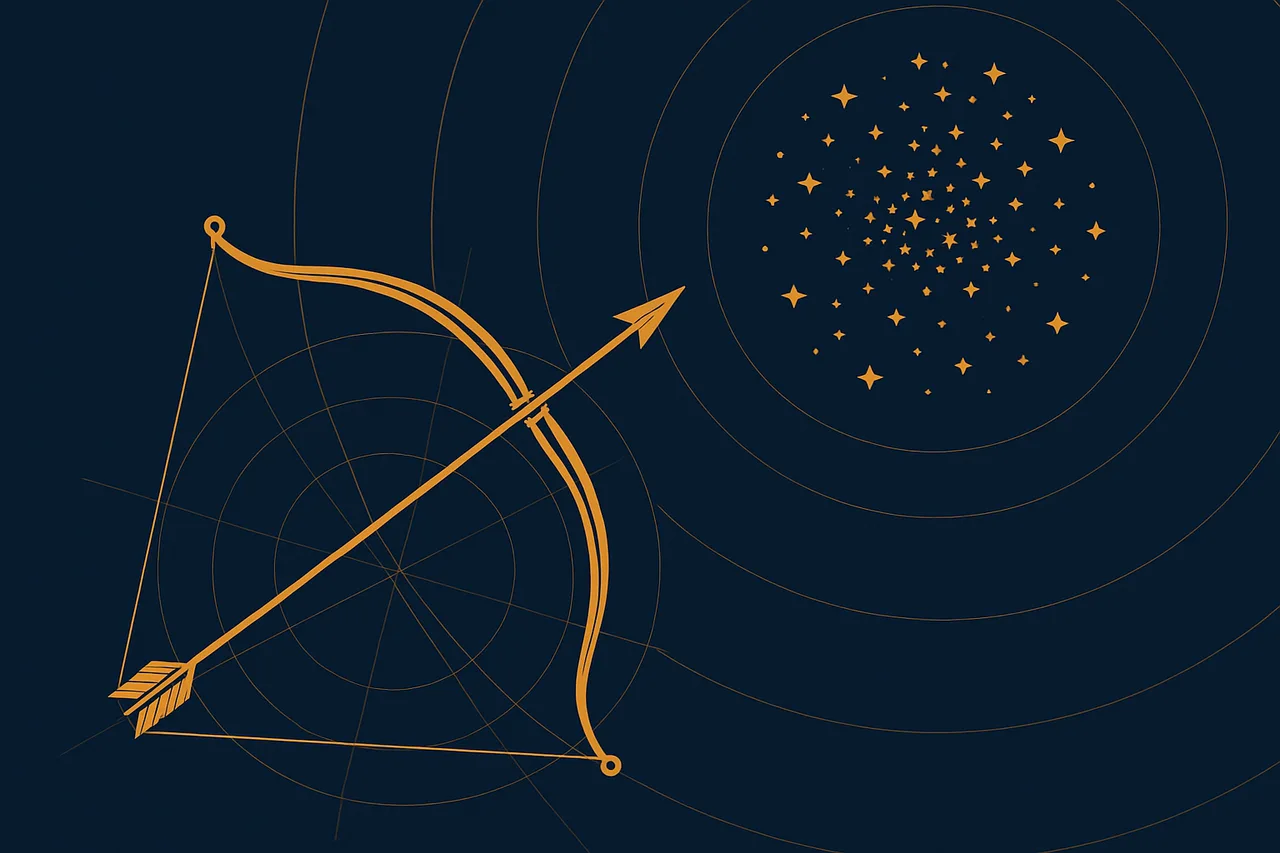
Dhanu (Dhanus) (Sagittarius) · 240°–270° sidereal longitude · rashi lord Guru (Jupiter) · Agni (Fire)
Rashifal reads the Moon, not the Sun. Your janma rashi is the sign the Moon occupied at your birth, and in Jyotish the Moon is manas — the receiving, reacting mind. For Dhanu that changes the picture more than most readers expect, because almost everything written in English about Sagittarius describes a Sun placement: the traveller, the optimist, the one who says the blunt thing. A Dhanu Moon is quieter than that and considerably less casual. What it actually runs on is a need for the thing in front of it to mean something. Not to be pleasant, not to be successful — to point somewhere.
The structural reason sits in one classical fact that generic Sagittarius pages never mention: Jupiter holds his moolatrikona in Dhanu, from 0° to 10° of the sign, and nowhere else. Jupiter rules two signs, Dhanu and Meena, but his seat of greatest functional strength short of exaltation exists only here. That is the sharpest available line between the two Jupiter Moons. In Meena, Jupiter is at home in water — dissolving, forgiving, absorbing. In Dhanu he is at his strongest in fire, and fire does not absorb anything. A Dhanu Moon converts belief into direction; a Meena Moon converts it into compassion. Same graha, different job.
And then the fact that gives this sign its real texture, which is arithmetic rather than doctrine. Dhanu begins at exactly 240°, which is also exactly where the nakshatra Mula begins — one of only three points in the whole zodiac where a sign boundary and a nakshatra boundary coincide. That coincidence is what makes Dhanu hold two entire nakshatras and a single stray pada, the most lopsided nakshatra distribution any rashi can have. It also means Jupiter owns this sign without ruling a single one of its nakshatras. The nine padas of Dhanu answer to Ketu, Venus and the Sun. Meena, by contrast, opens on Jupiter’s own Purva Bhadrapada pada. So a Dhanu Moon is a Jupiter mind operating on ground it does not administer — which is exactly why this sign so often believes one thing and finds itself living another.
The nakshatras of Dhanu — nine padas, two whole stars
Dhanu spans 240°–270° and begins exactly on a nakshatra boundary, which is why its nine padas split 4 + 4 + 1 rather than the 2–3 + 4 + 2–3 that most rashis get. Mula and Purva Ashadha both lie wholly inside this sign and inside no other; Uttara Ashadha lends only its first pada before the rest crosses into Makara. Each pada is 3°20′. The navamsa column follows the classical rule that a dual sign counts its navamsas from the fifth sign — for Dhanu that is Mesha, so the nine navamsas run Mesha through Dhanu in order, which makes the last pada of the sign vargottama. Every degree below is arithmetic you can check by hand.
Mula
240°00′ – 253°20′ (all four padas in Dhanu) · Pada 1 = 240°00′–243°20′ · Pada 2 = 243°20′–246°40′ · Pada 3 = 246°40′–250°00′ · Pada 4 = 250°00′–253°20′ · Lord: Ketu · Navamsa: Pada 1 → Mesha (Mars) · Pada 2 → Vrishabha (Venus) · Pada 3 → Mithuna (Mercury) · Pada 4 → Karka (Moon) · Shwan (dog) yoni · Rakshasa gana · Adi nadi
The root star, deity Nirriti, symbol a tied bundle of roots — and the opening thirteen degrees of your sign. Jupiter’s moolatrikona, 0°–10° Dhanu, sits exactly across padas 1–3, so this is simultaneously the most classically feared and the most functionally powerful stretch of Dhanu. Pada 1 is the gandanta slice at the Vrishchika–Dhanu seam and needs a confirmed birth time before anyone reads it. Padas 2 and 3, in Venus and Mercury navamsas, soften Ketu’s stripping instinct into research and articulation; pada 4, in a Karka navamsa, is where the sign’s excavating temperament finally attaches to people rather than to problems.
Purva Ashadha
253°20′ – 266°40′ (all four padas in Dhanu) · Pada 1 = 253°20′–256°40′ · Pada 2 = 256°40′–260°00′ · Pada 3 = 260°00′–263°20′ · Pada 4 = 263°20′–266°40′ · Lord: Shukra (Venus) · Navamsa: Pada 1 → Simha (Sun) · Pada 2 → Kanya (Mercury) · Pada 3 → Tula (Venus) · Pada 4 → Vrishchika (Mars) · Vanar (monkey) yoni · Manushya gana · Madhya nadi
The invincible star — deity Apah, the waters, symbol an elephant tusk and a fan. The second complete nakshatra inside Dhanu, and the only place in the zodiac where Venus rules a stretch of Jupiter’s fire sign outright. That pairing is the sign’s charm and its stubbornness in one: Purva Ashadha does not win arguments, it declines to concede them. Pada 3 in a Tula navamsa is Venus in his own division under his own star — the most persuasive and the most socially fluent ground in Dhanu. Pada 4 in a Vrishchika navamsa is the reverse: the same refusal to yield, now without the charm.
Uttara Ashadha
266°40′ – 280°00′ (pada 1 in Dhanu, padas 2–4 in Makara) · Pada 1 = 266°40′–270°00′ · Lord: Surya (Sun) · Navamsa: Pada 1 → Dhanu (Jupiter) — vargottama · Nakul (mongoose) yoni · Manushya gana · Antya nadi
A single pada, and the only slice of Dhanu where a luminary holds the star lord. Deity is the Vishwadevas, the all-gods, and the classical theme is the victory that does not need defending afterwards. This pada is vargottama — the navamsa returns to Dhanu itself — so the sign’s character is concentrated rather than modified, and a Moon here reads as the most straightforwardly Dhanu of the nine. It is also the closing three and a third degrees before Makara: ambition arrives, but Saturn’s sign has not started yet, so the discipline to carry it is borrowed rather than owned.
Four padas plus four padas plus one is nine, and nine × 3°20′ is 30° — the arithmetic check that this table is complete. If your Moon sits within roughly half a degree of 240°, 253°20′, 266°40′ or 270°, treat your nakshatra as unconfirmed until your birth time is verified: the Moon crosses a full pada in about six hours, so a few hours of error moves the navamsa lord, and that is a larger change to your reading than anything today’s transit will do.
Jupiter over a Dhanu Moon — and why it is not the Meena Jupiter
Jupiter is guru: expansion, meaning, teaching, law, the impulse to widen the frame. Put him in charge of the Moon and you get a mind that cannot leave a fact alone as a fact — it has to become a principle. A Dhanu Moon rarely says "that went badly"; it says "that is what happens when you trust the wrong process," and then it believes the principle more firmly than the incident warranted. This is the sign’s genuine gift and its recurring error in one motion. Nobody extracts a lesson faster than a Dhanu Moon, and nobody generalises from a single data point more confidently.
The dignity matters here in a way it does not for Meena. Moolatrikona from 0° to 10° Dhanu means Jupiter operates near full functional capacity in this sign, so the Jupiterian qualities arrive undiluted rather than softened: conviction is high, tolerance for a job that means nothing is low, and the instinct to advise is close to involuntary. Meena gives Jupiter ownership but not moolatrikona; his expression there is diffuse and receptive. That is the difference between a mind that teaches and a mind that holds. If you have been told your whole life that you are "too blunt" and you privately think you were simply being accurate — that is moolatrikona Jupiter in a fire sign talking, and it is worth knowing it is structural rather than a character flaw you failed to fix.
Now the cost, because it is specific and it is not the one Sagittarius pages usually name. Dhanu is dvisvabhava — dual, mutable — and Jupiter is a graha of expansion, not of closure. A dual fire sign under an expanding lord produces someone who begins with extraordinary energy and finishes considerably less often than they intend. The popular reading calls this restlessness. The more useful reading is that Dhanu has no natural braking mechanism in its own structure: the sign holds no exaltation degree and no debilitation degree, so nothing placed here is amplified or damped by the sign itself, and the sign’s lord is the one graha whose entire nature is "more." Dhanu natives who build a life they are happy with almost always did it by importing a limit from outside — a discipline, a partner, an institution, a deadline — rather than by finding one inside themselves.
Jupiter’s clock is also slower than most rashifal pages let on, and for a Dhanu Moon it is your own clock. Jupiter takes roughly twelve to thirteen months per sign, so each of your twelve houses gets one visit from your dispositor about once every twelve years. He also turns retrograde once a year for about four months — the 2025–26 retrograde ran roughly mid-November 2025 to mid-March 2026, and the next runs from about mid-December 2026 to mid-April 2027, each roughly 120 days. That means your rashi lord spends about a third of every year moving backwards. For a Dhanu Moon those months read as the belief being re-examined rather than the plan being blocked, which is a different feeling from the communications-static story people attach to Mercury retrograde. Meena Moons feel the same station; they just feel it as withdrawal rather than as re-argument.
The sky counted from Dhanu — 7 August 2026
Every position below was computed for the stamped date on the Lahiri ayanamsa and is counted FROM Dhanu, which is the only way transits mean anything for a Moon sign.
The defining feature of this sky for a Dhanu Moon is a stack in the 8th. Counting from Dhanu, the 8th house is Karka, and on 7 August 2026 it holds three grahas: the Sun at 20°47′, Mercury at 2°09′, and Jupiter at 13°49′ — Jupiter exalted by sign, since Cancer is his exaltation. So your own rashi lord is at his strongest and is sitting in the house of upheaval, inheritance, joint money, and things you find out rather than things you are told. That combination is easy to misread in both directions. It is not a disaster transit; exalted Jupiter in the 8th is classically one of the better places to be doing research, unwinding an old obligation, or receiving something you did not earn in the ordinary way. But it is not comfort either. The 8th does not hand you things in daylight.
Saturn is in Meena, the 4th from Dhanu, at 20°07′ and retrograde — he stationed around late July 2026 and turns direct around mid-December 2026. The 4th from the Moon is home, the mother, property, vehicles, and the specific commodity Jyotish calls sukha: the ability to be at rest where you live. Saturn there is a slow compaction of exactly that. Not conflict — weight. Dhanu natives typically report this stretch as a house that needs work, a parent who needs attention, or a private inability to relax that has no obvious external cause. Saturn leaves Meena for Mesha around mid-2027, retrogrades back for a final pass that autumn, and clears the sign for good in early 2028. Some traditions call Saturn in the 4th, 7th or 10th from the Moon Kantaka Shani; the schools differ on which houses count, and we would rather name the 4th-house content than argue the label.
Rahu is in Kumbha at 6°22′, the 3rd from Dhanu, and moves into Makara — your 2nd — in early December 2026. Ketu sits opposite in Simha, the 9th from Dhanu, until the same handover. That axis is worth reading carefully because of which houses it occupies for you specifically. Rahu in the 3rd is appetite pointed at effort, initiative and siblings; it is one of the placements the tradition treats as productive rather than troubling. Ketu in the 9th, for a sign whose entire nature is dharma and direction, is the harder half: the 9th is belief, teachers, the father, and the long journey, and Ketu there empties rather than obstructs. A great many Dhanu natives have spent 2025 and 2026 unable to say what they are actually for, having previously always known. That is a transit, not a verdict, and it lifts when the axis shifts.
The dated change most worth waiting for is Jupiter into Simha — your 9th — in early November 2026. Your own rashi lord, who is also the natural karaka of dharma, arriving in the dharma trikona, in the same month Ketu prepares to leave it. But it is a false start, and this page will say so rather than sell it: Jupiter stations retrograde in early Simha around mid-December 2026, slips back into Karka in late January 2027, turns direct in mid-April 2027, and only re-enters Simha for the real stay around late June 2027. He and Ketu also share that 9th house for roughly a month, from early November to early December 2026. So the honest shape is a preview in late 2026 and the substance in the second half of 2027. If a page tells you Dhanu’s luck turns in November 2026 and stops there, it has read the first ingress and not the retrograde.
One thing that does NOT apply to you, and it is the single most useful line on this page for a Dhanu Moon: you are not in Sade Sati and will not be for a long time. Sade Sati runs while Saturn transits the 12th, 1st and 2nd from the Moon — for Dhanu that means Vrishchika, Dhanu itself, and Makara. Saturn entered Vrishchika in late 2014, was in Dhanu from early 2017 to early 2020, and left Makara in January 2023. Your cycle is genuinely finished. On our scan Saturn does not return to Vrishchika until around the end of 2043. Anyone selling a Dhanu native Sade Sati remedies in 2026 is either not calculating or not being honest, and it is the easiest claim on this page to check for yourself.
Mula, gandanta, and what the tradition actually says
Dhanu opens on Mula, and Mula carries heavier classical language than any other nakshatra in this sign — so it deserves a straight answer rather than either a scare or a shrug. The facts first. Mula means "root." Its lord is Ketu. Its symbol is a tied bundle of roots. Its presiding deity is Nirriti, whose name means dissolution or disorder, and who in the Vedic scheme governs what comes apart. Its gana is Rakshasa and its yoni is the dog. None of that is invented and none of it is soft, and a page that omits it to be reassuring is not being kind, it is being unhelpful.
Then the boundary, which is where most retellings go wrong. The classical concern is not attached to Mula as a whole. It is attached to gandanta — the seam where a water sign ends and a fire sign begins. There are exactly three such seams in the zodiac (Meena into Mesha, Karka into Simha, Vrishchika into Dhanu), and they are the only three points where a sign boundary and a nakshatra boundary fall on the same degree. That is not a coincidence the tradition noticed and mythologised; it is the reason the concept exists. For Dhanu the seam is 240° — the last pada of Jyeshtha on one side, the first pada of Mula on the other. Definitions of how wide the sensitive zone is genuinely differ: some texts take the full pada either side, about 3°20′; the narrower "abhukta mula" reading takes only a few ghatikas at the exact junction, well under a degree. We are not going to pretend that disagreement is settled.
So here is what it does and does not predict. It does not predict misfortune for your family. Older texts framed gandanta birth as a risk to the father or to the household and prescribed shanti rituals accordingly, and that framing belongs to its period; we will report it as tradition and decline to repeat it as a forecast. What the placement does describe, and describes well, is a life that begins at a seam — where the inherited version of things does not carry over, and roots have to be grown rather than received. Mula-born natives are characteristically people who went down to the bottom of something and pulled it up to look at it. That is a real signature, and it is closer to an aptitude than to a wound.
There is also a structural fact that almost nobody puts next to the scary paragraph, and it changes the balance. Jupiter’s moolatrikona in Dhanu runs 0° to 10° of the sign — which is 240° to 250°, which is exactly padas 1, 2 and 3 of Mula. The three degrees-ranges where the sign’s lord is at his greatest functional strength sit entirely inside Ketu’s nakshatra. A nakshatra that contains the best degrees of its sign’s ruler is not a cursed stretch of zodiac. It is the part of Dhanu where the sign’s two natures — Jupiter’s meaning-making and Ketu’s stripping-away — are pressed into the same few degrees, which is uncomfortable and productive in roughly equal measure.
Practical note, because this is the one place on the page where precision genuinely matters: the Moon covers a full pada of 3°20′ in about six hours. If you were born anywhere near 240° sidereal, a birth time that is wrong by a few hours can move you into or out of the gandanta slice entirely. Do not accept a gandanta reading — from us or anyone — on an approximate birth time. Confirm the time first; the claim is unfalsifiable until you do.
Timing and remedial practice for Dhanu
The weekday is Guruvar, Thursday, because Jupiter rules the sign — a day Dhanu shares with Meena. The Dhanu-specific refinement is not the day but the state of the planet on it. Jupiter is retrograde for roughly four months of every year, and a Guruvar during a Jupiter retrograde is not the same instrument as one when he is direct. For most Moon signs that distinction is academic. For Dhanu and Meena it is your own dispositor, and the two use it differently: a Dhanu Moon should treat direct-Jupiter Thursdays as the window for committing to a direction and retrograde-Jupiter Thursdays as the window for re-examining one you already committed to. Beginning something new during your own lord’s retrograde is the characteristic Dhanu timing error, precisely because the conviction feels strongest exactly when it is being revised.
For deity association Dhanu gives you three anchors rather than one, because it holds two complete nakshatras and no other sign holds either of them entire. Mula belongs to Nirriti, dissolution. Purva Ashadha belongs to Apah, the waters — the nakshatra of the invincible, whose traditional practice is water offering and whose theme is cleansing rather than conquest. Uttara Ashadha’s single pada in Dhanu belongs to the Vishwadevas, the "all-gods," associated with enduring, uncontested victory. Read in order across the sign, 240° to 270°, that is a sequence rather than a list: what falls apart, what washes clean, what lasts. For a Dhanu native looking for a practice with an actual footing in their own chart, the Apah water offering on a Guruvar is better grounded than a generic Jupiter remedy, because Purva Ashadha lies wholly inside your sign and nowhere else.
On gemstones, the honest position for Dhanu is narrower than the internet’s. Yellow sapphire, pukhraj, is Jupiter’s stone and Jupiter rules Dhanu, which is where the standard recommendation comes from. But gemstone safety is graded from the ASCENDANT, not the Moon sign, and for a Dhanu ascendant specifically the grading is unusually restrictive: Jupiter, the Sun and Mars are the functional benefics; Venus, Mercury and Saturn are all functional malefics; and Dhanu is one of the lagnas with no yogakaraka at all — there is no single planet that lords both a kendra and a trikona for you. Two consequences follow. Diamond and emerald, the two stones most commonly sold as general good fortune, are Venus and Mercury stones and are the wrong prescription for a Dhanu ascendant. And if you only know your Moon sign, nobody can grade any of this, because the grading needs a birth time. We would rather say that than sell you a stone.
Who owns the houses from Dhanu — Saturn on the second and third, and a luminary on the eighth
The fixed layer beneath the gochar: which graha is answerable for each department, whatever is transiting it today.
Counted from Dhanu, Saturn lands on the 2nd and the 3rd — Makara and Kumbha, side by side on your savings and on your own initiative. That is the pair worth sitting with, because it is where this sign’s reputation and its structure disagree. Dhanu is described as expansive, lucky, generous with resources; the map says the accumulation of resources and the effort to generate them both report to the slowest and most exacting graha in the scheme. Not a contradiction of the sign so much as its counterweight: the optimism is Jupiter’s, and the invoice is Saturn’s, and they are in different houses.
The 8th is the fact almost nobody counts. Karka is the 8th from Dhanu, and the Moon owns Karka and nothing else — so your house of inheritance, upheaval and joint resources belongs to a graha with only one address and the fastest cycle of the seven. Only two rashis have a luminary on the 8th; Makara is the other, with the Sun. The practical read is that Dhanu’s crises are not slow-building, they are tidal — they arrive, crest and recede on a lunar rhythm rather than a Saturnine one. Your own lord doubles into the 4th: Jupiter owns Dhanu and Meena, so belief and home run through one planet. Mercury takes the 7th and 10th, Venus the 6th and 11th, Mars the 5th and 12th.
Set against the computed sky, this is the line that only the lordship map produces. On 7 August 2026 Jupiter was exalted at 13°49′ Karka, in your 8th — your own rashi lord, at its strongest available dignity, standing in the house owned by the Moon and dealing in what is hidden and shared. The Sun at 20°48′ and Mercury at 2°09′ were there with it, and Mercury owns your 7th and 10th. Saturn, holding your 2nd and 3rd, was retrograde in your 4th. The 1st, 2nd, 5th, 11th and 12th carried no slow planet.
Dhanu, Sagittarius, and why your dates may not line up
Dhanu (also written Dhanus) is Sagittarius. The Sanskrit word means the bow — the instrument, not the archer holding it. That is a more accurate summary of the sign than the English adjectives attached to it, because a bow is a device for converting stored tension into distance in one direction. It is useless without a target and it does not carry anything itself. Dhanu natives who cannot name what they are aiming at are not relaxed; they are a drawn bow with nowhere to release.
The dates are the first place confusion starts, so here they are separately and computed rather than remembered. Vedic astrology uses the sidereal zodiac with the Lahiri ayanamsa. On our calculation the Sun entered sidereal Dhanu on 17 December 2026 and left for Makara on 15 January 2027. Western astrology uses the tropical zodiac, where Sagittarius runs roughly 22 November to 21 December. The gap is about twenty-five days and it is not an error in either system — it is accumulated precession, which the sidereal zodiac tracks and the tropical one does not. The practical result is that a great many lifelong Western Sagittarians compute as Vrishchika in a Vedic chart, and people born in early January discover they are sidereal Dhanu having never once been called a Sagittarius.
But the dates are the smaller problem, and this is the part worth reading twice. Everything above concerns the SUN. "Dhanu Rashi" in Indian practice means your MOON sign — where the Moon actually stood at the hour you were born — and that is what this entire page is written for and what all the transit arithmetic above is counted from. The Moon changes sign roughly every two and a quarter days, so no date range can ever give it to you; it needs your birth date and, for the pada, your birth time. Statistically about one person in twelve with a Sagittarius Sun also has a Dhanu Moon. If you arrived here from a Western horoscope, the accurate statement is that you may or may not be Dhanu Rashi at all, and computing a chart is the only way to settle it. We would rather send you to find out than let you read a page written for someone else’s Moon.
Jupiter’s clock, read from a Dhanu Moon
Every rashifal page will tell you Jupiter rules Dhanu. Fewer will tell you what that means on a calendar — which is the part that actually decides when your years feel like they are going somewhere. Cycle lengths below are from the transit scan; house numbers are counted from Dhanu.
| Cycle | Length | What it means for Dhanu specifically |
|---|---|---|
| Jupiter through one sign | ≈12–13 months | Each of your twelve houses receives a visit from your own rashi lord roughly once every twelve years. That is the real rhythm of a Dhanu life, and it is much slower than the daily reading implies. He is in Karka — your 8th — through 2026, and reaches Simha, your 9th, in early November. |
| Jupiter retrograde | ≈120 days a year | Roughly a third of every year, your dispositor moves backwards. Mid-November 2025 to mid-March 2026, then mid-December 2026 to mid-April 2027. For a Dhanu Moon these are re-argument months, not blocked months — the conviction gets audited, and it usually survives in an amended form. |
| Jupiter’s moolatrikona | 0°–10° Dhanu | Exists in your sign and nowhere else — not in Meena, Jupiter’s other house. It coincides exactly with padas 1–3 of Mula. This is the single strongest structural argument that Dhanu, not Meena, is Jupiter’s working sign. |
| Jupiter’s return to Dhanu | Every ≈12 years | On our scan Jupiter re-enters Dhanu around February 2031, retrogrades back to Vrishchika that June, and returns to stay from about October 2031. A Jupiter return over the natal Moon is the closest thing a Dhanu Moon has to a personal new year, and it is five years out from the date stamped on this page. |
| What Jupiter does not settle | — | Whether Jupiter is a functional benefic for you is decided by your ascendant, not your Moon. For a Dhanu ascendant he is, and he rules the 1st and the 4th. For a Vrishabha or Kanya ascendant the same planet rules different houses and the verdict inverts. Any page prescribing a Jupiter remedy off your rashi alone has skipped the step that decides the answer. |
Cycle lengths and dates were derived from a day-step scan of computed sidereal positions, 2025–2032. Months rather than dates, because the module that produced them is sign-accurate rather than arc-second.
Where today's sky lands for a Dhanu (Dhanus) Moon
- Work
- 10th from Dhanu = Kanya (Mercury), with Venus at 6°07′ Kanya on 7 Aug 2026 — and Mercury a functional malefic for a Dhanu ascendant
- Counting from Dhanu, the 10th is Kanya, so your house of standing and profession answers to Mercury — the detail planet — while your Moon answers to Jupiter, the big-picture planet. That mismatch is the most reliably diagnostic thing about a Dhanu working life. You are graded on precision in a domain your mind processes as principle, which is why Dhanu natives so often do excellent work and get feedback about the paperwork. On 7 August 2026 Venus sits at 6°07′ in that 10th house, which is a genuinely favourable placement for negotiation, presentation and being liked at work — and a poor one for pushing a confrontation you have been postponing. Note also, if Dhanu is your rising sign and not only your Moon, that Mercury is a functional malefic for that lagna, which makes "just be more detailed" worse advice for you than it sounds.
- Money
- 2nd from Dhanu = Makara (Saturn), with Rahu entering it in early December 2026; 8th from Dhanu = Karka, carrying Sun, Mercury and exalted Jupiter
- Dhanu’s two money houses are as different as two houses get. The 2nd — savings, stored value, what you have — is Makara under Saturn, which is slow, literal and unimpressed by potential. The 8th — joint money, inheritance, other people’s resources, insurance, anything that arrives by a route you did not design — is Karka under the Moon, and on 7 August 2026 it holds three grahas including your own rashi lord exalted. Read together, that is the specific Dhanu financial shape: earned money accumulates grudgingly, and unearned or structurally-routed money is where the live activity is this year. The dated change to plan around is Rahu moving into your 2nd in early December 2026, which historically reads as appetite arriving in the savings house — expansion of what you own, and a matching tendency to overreach on it. The recurring Dhanu money leak is not overspending; it is committing to a plan on the strength of the principle before checking the arithmetic.
- Relationships
- 7th from Dhanu = Mithuna (Mercury), with Mars at 2°50′ Mithuna on 7 Aug 2026
- The 7th from Dhanu is Mithuna, which places Mercury — talk, variety, information — in charge of your partnerships and sets Dhanu opposite its own polarity: the sign that wants the single meaning looking across at the sign that wants every option. In practice a Dhanu Moon is drawn to partners who are quick, plural and hard to pin, and then experiences that quality as evasiveness. This is not a compatibility verdict; it is the axis you are standing on. On 7 August 2026 Mars is at 2°50′ Mithuna, sitting in that 7th house — assertive, impatient, and directly opposite your Moon sign. Mars in the 7th from the Moon is the classical signature for friction in partnership: not necessarily conflict, but a lowered tolerance for being managed. It is a poor fortnight for issuing an ultimatum and a good one for finishing a difficult conversation you have already started.
- Health
- Dhanu as Jupiter’s fire sign (pitta–kapha); hips and thighs in the Kalapurusha; Saturn transiting Meena, the 4th from Dhanu
- Dhanu carries a constitutional signature that Meena does not, and this is where the two Jupiter Moons must be read apart. Jupiter is the kapha graha and Dhanu is his fire sign, so the tendency here is pitta over a kapha base — heat, appetite and expansion rather than the damp heaviness of a water-sign Jupiter. In the Kalapurusha scheme Sagittarius governs the hips and thighs, which is where this sign’s complaints tend to present: hip flexors, sciatic irritation, the thigh and lower-back chain, and the joint wear that follows from a body that likes long movement and dislikes sustained stillness. The live pressure in this window is Saturn in the 4th from your Moon, and the 4th is rest — so the practical instruction for a Dhanu native right now is sleep and stillness, which is precisely the discipline this sign is worst at. None of this is a diagnosis, and a Dhanu Moon with a real symptom needs a doctor, not a rashifal.
Dhanu (Dhanus) rashifal — frequently asked
Is Dhanu rashi in Sade Sati in 2026?
No, and not remotely. Sade Sati runs while Saturn transits the 12th, 1st and 2nd houses from your Moon sign — for Dhanu that is Vrishchika, Dhanu itself, and Makara. Saturn entered Vrishchika in late 2014, occupied Dhanu from early 2017 to early 2020, and left Makara in January 2023. Your cycle finished more than three years ago. On our scan Saturn does not reach Vrishchika again until around the end of 2043, so Dhanu is currently about as far from Sade Sati as a Moon sign can be. What you do have is Saturn in Meena, the 4th from your Moon, which is a real transit with real weight — home, property, rest and the mother — but it is a different thing with a different shape, and it ends when Saturn clears Meena in early 2028.
Which nakshatras fall in Dhanu rashi?
Three, and unusually, two of them lie wholly inside the sign. Mula contributes all four padas (240°00′–253°20′, lord Ketu). Purva Ashadha contributes all four padas (253°20′–266°40′, lord Venus). Uttara Ashadha contributes only its first pada (266°40′–270°00′, lord Sun) before the remaining three cross into Makara. That 4 + 4 + 1 split is possible because Dhanu begins at exactly 240°, which is also exactly where Mula begins — one of only three points in the zodiac where a sign boundary and a nakshatra boundary coincide. Nine padas of 3°20′ each, totalling the sign’s 30°.
I was born in Mula nakshatra. Is that unlucky?
Not in the way the internet says, and the honest answer has three parts. First, the tradition is real and we will not hide it: Mula’s lord is Ketu, its deity is Nirriti, and older texts prescribed shanti rituals for birth at the gandanta seam, historically framed as a risk to the father or household. Second, the scope is much narrower than usually reported — the classical concern attaches to the junction at 240°, not to all thirteen degrees of Mula, and schools disagree about whether the sensitive zone is the full 3°20′ pada or only a few ghatikas at the seam. Third, and rarely mentioned: Jupiter’s moolatrikona in Dhanu runs 0°–10°, which is exactly Mula padas 1 to 3, so the stretch of zodiac in question also contains the strongest degrees of the sign’s own ruler. A nakshatra holding its lord’s best degrees is not a curse. And if your birth time is approximate, none of this is checkable anyway — the Moon crosses a pada in about six hours.
What is the difference between Dhanu rashi and a Sagittarius sun sign?
Two differences stacked on top of each other. First, planet: Dhanu Rashi in Indian practice means your MOON sign, while a Western "Sagittarius" is your Sun sign — different graha, different question, and only about one Sagittarius in twelve also has a Dhanu Moon. Second, zodiac: Vedic astrology is sidereal with the Lahiri ayanamsa, and on our calculation the Sun was in sidereal Dhanu from 17 December 2026 to 15 January 2027; Western astrology is tropical, where Sagittarius runs roughly 22 November to 21 December. The twenty-five-day gap is precession, not an error in either system. So plenty of lifelong Sagittarians compute as Vrishchika in a Vedic chart. Since the Moon changes sign every two and a quarter days, no date range can give you your rashi — it has to be computed from your birth date.
Should a Dhanu native wear a yellow sapphire (pukhraj)?
Not on the basis of your Moon sign, and we will not pretend otherwise. Yellow sapphire is Jupiter’s stone and Jupiter rules Dhanu, which is where the recommendation always comes from — but gemstone safety is graded from the ASCENDANT, because a gem amplifies whatever a planet does for that lagna. If Dhanu is also your rising sign, Jupiter genuinely is a functional benefic there and pukhraj is defensible; note in the same breath that Venus, Mercury and Saturn are all functional malefics for a Dhanu ascendant, and that Dhanu is one of the lagnas with no yogakaraka at all. That makes diamond and emerald — the two stones most often sold as general good luck — actively wrong prescriptions for you. If all you know is your Moon sign, the grading cannot be done, and no stone should be prescribed off this page.
What this page can NOT tell you
- A rashifal describes a transit as it lands on roughly one-twelfth of everyone alive. Saturn genuinely is in the 4th from every Dhanu Moon today — that part is real arithmetic, not a horoscope. What it cannot tell you is which of your fourth-house matters it will touch, because that needs your houses, and houses need a birth time.
- This page reads the Moon only. It does not know your ascendant, your Vimshottari Mahadasha, or which planets sit natally in which of your houses. For Dhanu that gap bites in a specific place: Jupiter is both your rashi lord and the graha every remedial recommendation will point at, and whether he is working for you or against you flips entirely on the ascendant. A supportive gochar during an unhelpful sub-period is a door that opens onto a wall.
- The pada matters more than the sign, and this page cannot know yours. A Dhanu Moon in Mula pada 1 — gandanta, Ketu, a Mesha navamsa — and one in Uttara Ashadha pada 1 — vargottama, the Sun, the sign’s own navamsa — sit at opposite ends of the same thirty degrees and read almost nothing alike. If your birth time is approximate, resolve that before trusting any pada-level statement, here or anywhere.
- We have flagged one genuine disagreement rather than papering over it: how wide the gandanta zone at 240° actually is. Some schools take the full pada either side of the seam, others take only a few ghatikas. We have given the range and declined to pick. We have also reported the older ritual framing of Mula birth as tradition, and we do not endorse it as a prediction about your family.
- Transit positions here are stamped to the date they were computed for, and the slow planets have moved on their own clock ever since. Ingress and station months on this page carry real uncertainty because the engine that produced them is sign-accurate rather than arc-second — that is why we say "early November 2026" rather than a day. Once the stamp above is behind you, treat this block as history and read the live panel.
- Nothing here is medical, legal or financial advice, and no honest Jyotish reading names an outcome as certain. We describe windows and pressures. That caveat matters more than usual for a sign whose lord is conviction itself: a Dhanu Moon will take a well-argued paragraph as a principle to act on, and this one is not meant that way.
All positions on this page are sidereal, computed with the Lahiri (Chitra-paksha) ayanamsa. Transit positions were computed for 7 August 2026, and ingress and station statements are given at month resolution because the fast module behind them is sign-accurate rather than arc-second; day-precise moments belong to the full Swiss Ephemeris chart engine, which is what the live panel quotes. The nakshatra and pada table was derived from the repo’s own pada arithmetic rather than typed by hand. Classical claims — Jupiter’s moolatrikona at 0°–10° Dhanu, the navamsa counting rule for dual signs, the nakshatra lords, deities, ganas and yonis, and the gandanta junction at 240° — follow Brihat Parashara Hora Shastra and the standard avakhada tables. Where schools genuinely disagree, such as the width of the gandanta zone or which houses from the Moon count as Kantaka Shani, we say so on the page rather than picking one silently.
How AskSoma computes and what we refuse to claim · Engine: Swiss Ephemeris for full birth charts; a lightweight truncated-series engine for the live sky panel and the transit scan behind this page. · Ayanamsa: Lahiri (Chitra-paksha) — the Rashtriya Panchang standard. · Content reviewed 2026-08-07 · Transit positions computed for 2026-08-07
What people rate AskSoma
4.8/5 from 100+ reviews on the selected public wall; 4.5/5 on Trustpilot from 16 reviews; 9.6/10 average across 286 selected satisfaction responses. Figures as of 2026-06-25. Satisfaction is not Net Promoter Score.
About the author
Written by Savan Vyas, founder of AskSoma.
The astrology is not written from memory: every chart position, dasha period and panchang timing AskSoma shows is computed with the Swiss Ephemeris on the Lahiri (Chitrapaksha) ayanamsa. How we calculate.