Karka (Kark) Rashifal — Daily Vedic Reading for the Cancer Moon Sign
The direct answer: Karka (Kark) Rashifal — Daily Vedic Reading for the Cancer Moon Sign: Kark rashifal is the daily reading for a Moon between 90° and 120° sidereal — the sign English calls Cancer. Karka is ruled by the Moon itself, so its lord comes home every 27.3 days; every other rashi waits a year or a decade. Karka also holds Jupiter’s exaltation at 5° and Mars’s fall at 28°. AskSoma publishes this at asksoma.ai/rashifal/kark as a free Vedic astrology resource using Swiss Ephemeris calculations and classical Jyotish interpretation — not generic sun-sign copy.
Kark rashifal is the daily reading for a Moon between 90° and 120° sidereal — the sign English calls Cancer. Karka is ruled by the Moon itself, so its lord comes home every 27.3 days; every other rashi waits a year or a decade. Karka also holds Jupiter’s exaltation at 5° and Mars’s fall at 28°.
Start with your own chart
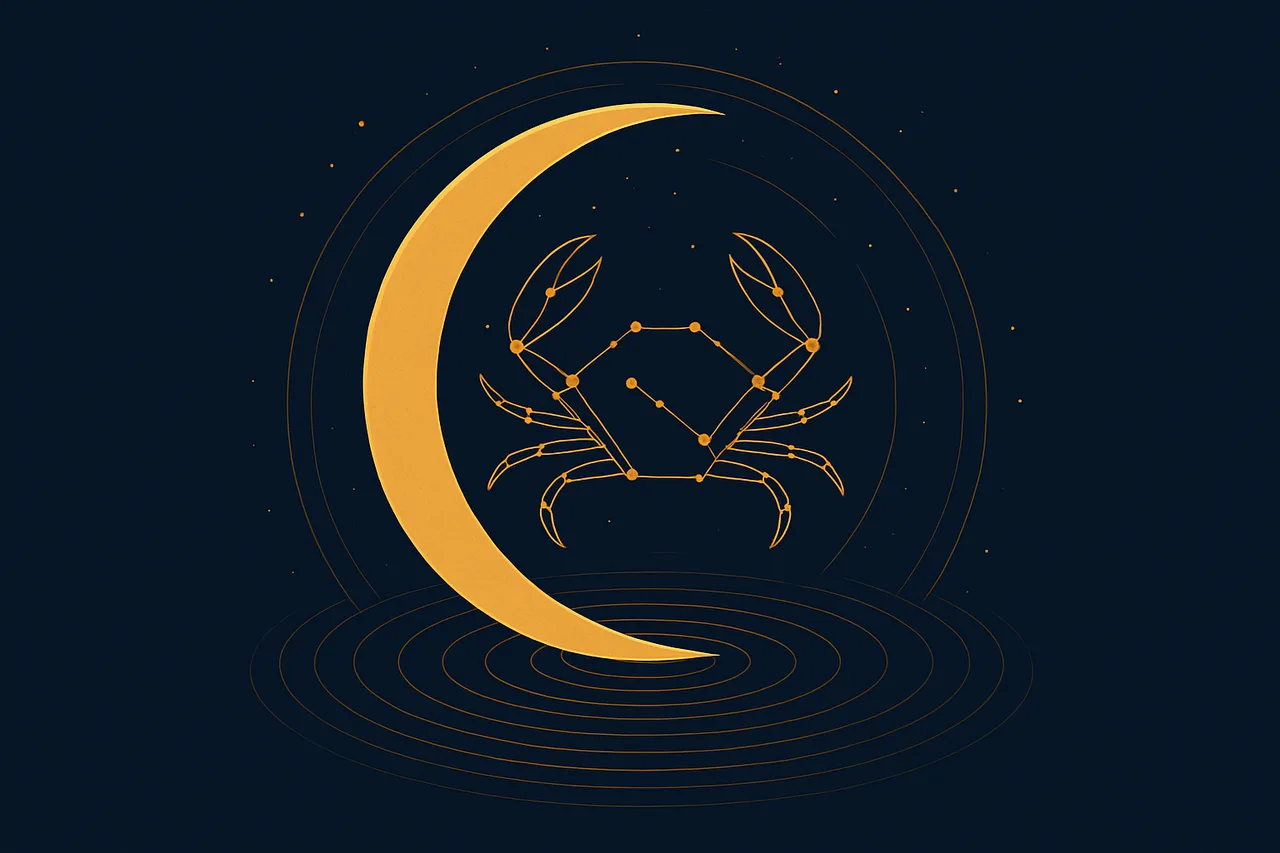
Karka (Kark) (Cancer) · 90°–120° sidereal longitude · rashi lord Chandra (the Moon) · Jala (Water)
There is one thing about Kark rashi that no other sign page can claim, and it is not a personality trait. A Vedic rashifal is calculated from the Moon — your janma rashi is where the Moon stood at your birth, and every transit on a rashifal is counted outward from that point. Karka is the sign the Moon owns. So for a Kark native, the instrument and the subject are the same graha: the Moon is reading its own house.
That is not poetry, it is orbital mechanics with a consequence. The Moon completes the sidereal zodiac in 27.32 days, moving somewhere between about 12° and 15° a day. It therefore returns to Karka roughly thirteen times a year. Compare the other eleven: the Sun brings Simha its lord once a year, Mercury and Venus stay tethered to the Sun and manage about the same, Mars needs 1.88 years for Mesha and Vrishchika, Jupiter 11.86 years for Dhanu and Meena, and Saturn 29.46 years for Makara and Kumbha. A Makara native meets their own sign lord at home two or three times in a lifetime. A Kark native meets theirs monthly.
The second structural fact is the pair of degrees written into the sign. Jupiter reaches its exaltation at 5° Karka and Mars its deepest debilitation at 28° Karka — the highest dignity of the greatest benefic and the lowest of the fiercest malefic, inside the same thirty degrees, twenty-three degrees apart. Check where each lands and the sign explains itself: 5° Karka sits inside Pushya, whose presiding deity is Brihaspati — Jupiter is exalted inside the nakshatra named for him. And 28° Karka sits in Ashlesha pada 4, the serpent, the only Rakshasa-gana ground in the sign. Karka does not hold benefic and malefic in tension by temperament. It holds them at measured addresses you can look up.
The nakshatras of Karka — one pada, then two complete stars
Karka spans 90°00′ to 120°00′, which is exactly nine padas of 3°20′. The distribution is unusual: one pada of Punarvasu, then all four of Pushya, then all four of Ashlesha. Holding two complete nakshatras puts Karka in a group of three — with Vrishchika and Meena, the other two water signs — and no other signs share it. The navamsa column follows the classical rule for a movable (chara) sign: the nine navamsas of Karka begin from Karka itself and run in order to Meena. Every degree below is arithmetic you can check by hand.
Punarvasu
80°00′ – 93°20′ (padas 1–3 in Mithuna, pada 4 in Karka) · Pada 4 = 90°00′–93°20′ · Lord: Guru (Jupiter) · Navamsa: Pada 4 → Karka (Moon) — vargottama · Marjar (cat) yoni · Deva gana · Adi nadi · deity Aditi · symbol the bow and quiver
Karka opens on three and a third degrees of vargottama ground: the navamsa of this pada repeats the rashi, so the sign is doubled rather than modified. Karka gets this by being a movable sign, a property it shares with Mesha, Tula and Makara, but Punarvasu is what makes it land well here — its name means "the good returned", Aditi is the mother of the gods, and the star is read as restoration after loss. Born in the first 3°20′ of Karka, the recurring shape of your life is the second attempt that works. Jupiter as star lord over a Moon in the Moon’s own sign is the gentlest opening any rashi gets.
Pushya
93°20′ – 106°40′ (all four padas in Karka) · Pada 1 = 93°20′–96°40′ · Pada 2 = 96°40′–100°00′ · Pada 3 = 100°00′–103°20′ · Pada 4 = 103°20′–106°40′ · Lord: Shani (Saturn) · Navamsa: Pada 1 → Simha (Sun) · Pada 2 → Kanya (Mercury) · Pada 3 → Tula (Venus) · Pada 4 → Vrishchika (Mars) · Mesha (ram) yoni · Deva gana · Madhya nadi · deity Brihaspati · symbol the cow’s udder
The nakshatra classical muhurta ranks as the most auspicious of the twenty-seven sits wholly inside Karka and inside no other sign. Its lord is Saturn and its deity is Brihaspati — Saturn’s discipline serving Jupiter’s purpose, in the Moon’s house. Jupiter’s exaltation degree, 5° Karka, falls in pada 1. The symbol is a cow’s udder: nourishment that is given, not traded. Born here you are the one people bring problems to, and the standing cost is that provision becomes identity. The navamsas walk Sun → Mercury → Venus → Mars, so the four padas run visibly from dutiful to analytical to diplomatic to sharp.
Ashlesha
106°40′ – 120°00′ (all four padas in Karka) · Pada 1 = 106°40′–110°00′ · Pada 2 = 110°00′–113°20′ · Pada 3 = 113°20′–116°40′ · Pada 4 = 116°40′–120°00′ · Lord: Budha (Mercury) · Navamsa: Pada 1 → Dhanu (Jupiter) · Pada 2 → Makara (Saturn) · Pada 3 → Kumbha (Saturn) · Pada 4 → Meena (Jupiter) · Marjar (cat) yoni · Rakshasa gana · Antya nadi · deity the Nagas · symbol the coiled serpent
The gana flips at 106°40′ and the whole texture of the sign changes with it — Punarvasu and Pushya are Deva gana, Ashlesha is Rakshasa. The last third of Karka is where the sign stops nourishing and starts watching. Mercury as star lord gives strategy to a lunar mind; the Nagas give it patience and a long memory. Mars reaches its deepest debilitation at 28° Karka, inside pada 4, which is the arithmetic behind Ashlesha’s reputation for holding force in reserve rather than spending it. Two Saturn navamsas in the middle make padas 2 and 3 the most self-contained ground in the sign.
Karka opens and closes on the same yoni — Marjar, the cat — because Punarvasu and Ashlesha share it, with Pushya’s ram in between. If your Moon is within roughly half a degree of 90°, 93°20′, 106°40′ or 120°, treat your nakshatra as unconfirmed until your birth time is accurate. The Moon covers about 0.55° an hour, so a two-hour error moves you a pada and a pada moves the navamsa lord — a bigger change to your reading than any transit on this page.
Why a Kark rashifal is different in kind, not just in content
The one sign where the ruling planet and the reading’s frame of reference are the same body.
Every rashifal on the internet is counted from the Moon. That is what makes it a rashifal and not a sun-sign horoscope: your rashi is the sign the Moon occupied at your birth, and today’s planets are placed in houses counted forward from it. For eleven signs the Moon is a neutral measuring stick — Makara borrows it to measure Saturn’s business, Simha borrows it to measure the Sun’s. Karka is the exception. When a Kark reading says the Moon is in your 7th today, it is reporting on your own dispositor’s whereabouts.
The practical consequences are specific and none of them are flattering or unflattering — they are mechanical. First, cadence. Because the Moon crosses a sign in about two and a quarter days, a Kark native gets a lunar return roughly every 27.3 days: two-odd days a month when the transiting Moon and the natal Moon share a sign and the ruler is, in the plainest sense, home. Those are the days a Kark reading runs strongest and, in our experience of what people report back, the days Kark natives least want to be around other people’s decisions. Simha gets that once a year. Makara gets it in 2005, 2034 and 2064.
Second, direction. The Moon never turns retrograde. Karka shares that with Simha alone; every other sign has a lord that stations and reverses — Mercury three times a year, Venus and Mars far less often, Jupiter and Saturn for months at a stretch. So the whole vocabulary of "your ruler is retrograde, revisit and review" simply does not apply to a Kark Moon. There is no built-in review period, which is precisely why Kark natives tend to keep moving forward through things that another sign would have been forced to re-examine.
Third — and this is the mechanic that replaces retrogression — brightness. The Moon is the only graha whose classical strength changes on a monthly clock independent of which sign it sits in. Paksha bala grades the Moon by its angular distance from the Sun: strongest at Purnima, weakest at Amavasya, when it is dark and combust. So a Kark native’s dispositor is not sometimes reversed, it is continuously dimming and refilling. If you have ever noticed that your appetite for hard conversations tracks a fortnightly rhythm rather than a weekly one, that is the mechanism, and it is the reason a Kark native gets more out of watching the tithi than the weekday. Once a year the Amavasya falls in Karka itself, because the new Moon always happens where the Sun is and the Sun crosses Karka annually — in 2027 that is approximately 19 July, computed. That is the single day in the year when a Kark native’s ruler is both dark and standing on their own sign.
One honest limit on all of this, because it is easy to over-read. None of it makes a Kark rashifal more accurate than any other sign’s. It makes it move faster, weights the lunar calendar above the solar one for you specifically, and means the thing being described — manas, the responsive mind — is also the thing doing the describing. That is an unusual arrangement. It is not an advantage.
The sky on 7 August 2026, counted from Karka
Positions computed for 12:00 UTC on the Lahiri (Chitra-paksha) ayanamsa. Houses are counted from Karka, which is the only way a transit means anything for a Moon sign.
Start with the headline, because it is genuinely the strongest transit statement available to any of the twelve rashis right now. Jupiter is at 13°49′ Karka — in the sign of its exaltation, and in the 1st from your Moon. For a Kark native that is the greatest benefic sitting at its highest sign dignity directly on the natal Moon. Jupiter had turned direct shortly before this date and is gaining speed. Guru conjunct Chandra is the configuration behind Gajakesari Yoga, and we will be exact about the boundary: a transit is not a natal yoga. What you have is the transit echo of it — a period, not a birth-chart asset. It is still the best fifteen months this Moon sign will see for a while.
It does not last continuously. On our calculation Jupiter leaves Karka for Simha, your 2nd, around 3 November 2026, retrogrades in early Simha around 14 December, and slides back into Karka around 22 January 2027 — turning direct at about 22°24′ Karka on 14 April 2027 before finally clearing the sign near 28 June 2027. So exalted Jupiter over a Kark Moon runs in two passes: now until early November, then again from late January to late June 2027. Kark natives who miss the first window have a second, which is not something transits usually offer.
The company is unusually crowded. The Sun is at 20°47′ Karka and Mercury at 2°09′ Karka on this date, both also in your 1st — the Sun crossed into sidereal Karka on 17 July 2026 and leaves for Simha on 17 August. Note what that does to the ruler: with the Sun in Karka, the Amavasya of this solar month falls in your own sign. Meanwhile the Moon itself is at 9°15′ Vrishabha — your 11th house, and, as it happens, the Moon’s own exaltation sign. That coincidence is structural rather than lucky. The 11th from Karka is Vrishabha and the Moon exalts at Vrishabha 3°, so a Kark native’s house of gains is permanently the place their dispositor reaches highest dignity. Only one other sign has that arrangement — Vrishabha, whose 11th is Meena where Venus exalts. It is a real feature of your chart geometry, not a coincidence of the date.
Now the pressure. Saturn is at 20°07′ Meena, retrograde, in your 9th — father, teachers, dharma, long-distance and the beliefs you inherited. Saturn turns direct in Meena around 12 December 2026 and moves into Mesha, your 10th, around 6 June 2027. A retrograde Saturn in the 9th from the Moon reads as a re-examination of an inherited framework rather than an obstacle, and it is a mild placement compared with what Saturn does closer in. Rahu is at 6°22′ Kumbha, your 8th, with Ketu opposite at 6°22′ Simha, your 2nd. That axis moves on approximately 6 December 2026 — and this is the dated change Kark natives should mark, because Ketu enters Karka itself while Rahu enters Makara, your 7th. The nodes are about to sit on your 1st and 7th for roughly eighteen months, until mid-2028.
Mars deserves its own paragraph for Karka and for no other sign. Mars is at 2°50′ Mithuna, your 12th, on this date, and enters Karka around 19 September 2026. Mars is debilitated in Karka — deepest at 28° — and Mars is also the yogakaraka for a Cancer ascendant, ruling both the 5th and the 10th. That collision is unique to this sign: the planet capable of doing you the most good in a Karka chart is the planet whose dignity is lowest in Karka. It gets sharper. Mars retrogrades in Simha in January 2027, reverses back into Karka around 9 March, and stations direct at roughly 26°18′ Karka on 2 April 2027 — within two degrees of its exact debilitation point, motionless, in Ashlesha pada 4. If any single moment on this page is worth a note in a diary, it is that one.
Timing and remedial practice for a Kark Moon
The weekday is Monday — Somvar — and Karka is one of only two rashis that does not have to share its day. The Moon rules exactly one sign and the Sun rules exactly one; the other five grahas rule two apiece, so Mithuna splits Wednesday with Kanya, Makara splits Saturday with Kumbha, and so on. Monday belongs to Karka alone. That said, we would rather you used the hora than the day: the first hora after sunrise on Monday is the Moon’s, and in the Chaldean order it returns every seventh hour after that. A correctly chosen Moon hora on any day beats treating a whole Monday as auspicious, which it is not.
For a Kark Moon the more powerful instrument is the tithi, for the reason set out above — your ruler’s strength is a fortnightly variable, not a weekly one. Shukla paksha, the bright fortnight, is when your dispositor is gaining paksha bala; Krishna paksha is when it is shedding it. Beginnings, negotiations and anything that needs you to hold your position land better in the waxing half. The two or three days around Amavasya are when a Kark native is most likely to mistake depletion for a verdict about their life. That is not a superstition about bad days; it is the classical strength grading applied to the one graha that happens to run your sign.
The deity anchors for Karka are unusually well-defined because two of its three nakshatras sit entirely inside the sign. Chandra Dev is the graha devata of the lord, and Somvar practice — the Monday fast, and in Shaiva tradition the association of the crescent Moon with Shiva — is the widespread North Indian custom; we name it as devotional tradition, which is what it is. The sign-specific anchors are sharper. Pushya’s deity is Brihaspati, and classical muhurta treats Pushya as the most auspicious of the twenty-seven nakshatras for beginnings — with one famous exception that is worth knowing precisely: Pushya is traditionally excluded for vivaha, marriage. Guru Pushya Yoga (Pushya falling on a Thursday) and Ravi Pushya (on a Sunday) are still widely observed across India for purchases, gold and new ventures. Ashlesha’s deity is the Nagas, and Naga worship — the Nag Panchami observance in particular — is the traditional practice associated with that star. A Kark native looking for something to actually do has these two, not just a generic Moon remedy.
On gemstones we will be direct, because Karka gets a specific bad recommendation more often than most. Pearl is the Moon’s stone and the Moon rules Karka, so pearl is prescribed to Cancer natives almost by reflex. The problem is that gemstone safety is graded by functional nature, and functional nature is reckoned from the ascendant, not the Moon. If Karka is also your rising sign, the standard Parashari grading gives you a genuinely counter-intuitive table: Mars is the yogakaraka, ruling the 5th and the 10th — the strongest single planet for this lagna, and the one nobody expects to be told to strengthen. Meanwhile Mercury and Venus, the two natural benefics people assume are always safe, are both functional malefics for a Cancer ascendant. An emerald or a diamond handed to a Karka lagna on general principle is a real mistake, and it is a common one. And if all you know is your Moon sign, the grading cannot be done at all — not by us and not by anyone. We would rather say so than sell you a stone.
Who owns your twelve houses — and why Karka’s lord has nowhere else to be
Not where the planets are today. Who is permanently answerable for each department, which is the layer under the daily reading.
Five of the seven classical grahas rule two signs each. The Sun and the Moon rule one apiece — Simha and Karka — so there are exactly two rashis in the zodiac whose lord carries no second portfolio, and yours is one of them. For a Karka Moon that has a quiet consequence: the graha responsible for your mind has no other department to be distracted by, no second house whose affairs compete for it. It also means the Moon appears once and only once on your map, in the 1st, so when a reading says "the Moon is in your 5th today" it is reporting on the whereabouts of your own dispositor and nothing else. There is no second address to check.
The pairing that does deserve attention is Saturn’s. Makara is the 7th from Karka and Kumbha is the 8th — his two signs, adjacent, sitting on the partner and on what is shared, inherited or endured. No other rashi puts them there. It is worth naming plainly because it is the honest structural version of a stereotype: Karka is not "afraid of commitment", Karka has the slowest and most exacting graha in charge of both the other person and the joint account. Elsewhere Mars takes the 5th and the 10th, so creative output and public standing move together; Jupiter takes the 6th and the 9th, obstacle and fortune; Mercury takes the 3rd and the 12th; Venus the 4th and the 11th.
Laid over the sky computed for this page, one thing stands out that no transit sentence says. On 7 August 2026 the 1st house — Karka itself — held the Sun at 20°48′, Mercury at 2°09′ and exalted Jupiter at 13°49′ all at once, and Jupiter is also the owner of your 6th and 9th. So your fortune-and-obstacle lord was at its ceiling, standing on your own sign. The Moon, your lord with nowhere else to be, was in the 11th. The 4th, 5th, 6th, 7th and 10th were empty of slow planets entirely.
Kark, Karka, Cancer — and why your Western sign probably does not match
Kark is the common Hindi spelling; Karka or Karkata is the Sanskrit, and it means the crab, which is the same animal the Latin Cancer names. So the sign is genuinely the same slice of sky by name. Two things separate the Vedic Kark rashi from the Western Cancer sun sign, and they stack.
The first is the zodiac itself. Jyotish uses the sidereal zodiac, fixed to the stars, with the Lahiri ayanamsa; Western astrology uses the tropical zodiac, fixed to the equinox. They have drifted roughly 24° apart. On our computation the Sun entered sidereal Karka on 17 July 2026 and left for Simha on 17 August 2026. Tropical Cancer runs about 21 June to 22 July. The overlap is only a few days, which is why so many lifelong Western Cancers compute as sidereal Mithuna. Neither system is wrong; they are measuring from different origins, and the gap is precession, not error.
The second difference is larger and the dates above have nothing to do with it. Kark rashi in Indian practice means your MOON sign — where the Moon stood at your birth — not your Sun sign. That is what this entire page is written for and what every transit above is counted from. The Moon changes sign every two and a quarter days, so no date range can give it to you; it needs your actual birth date, and ideally the time. A Western Cancer has roughly a one-in-twelve chance of also being Kark rashi, which is the same odds as any other sun sign.
There is one twist here that belongs to Karka and to no other sign, and it is worth stating because it cuts against the usual complaint. Popular Western writing about Cancer is built almost entirely on Moon symbolism — feeling, memory, home, tides — even though it is describing the Sun in that sign. That description is aimed at the wrong body. But Cancer is the Moon’s own sign, so the vocabulary accidentally points at the correct graha anyway. Of the twelve, Karka is the one place where sun-sign writing is least wrong by luck. That does not make it right about you. It means that if the Cancer descriptions have always felt approximately true, the honest next step is to check whether your Moon is actually here, because that is the placement the language was reaching for.
Karka’s structural anatomy — the facts that do not change with the date
Transits move; this table does not. Everything in it is either a classical position from Brihat Parashara Hora Shastra or arithmetic you can verify against any sidereal ephemeris.
- Lord: the Moon, and what that costs
- Chandra rules Karka and rules nothing else. Because the Moon has no second sign, a Kark native’s dispositor is never divided between two houses in the way Saturn’s, Jupiter’s, Mars’s, Venus’s and Mercury’s are for the signs they rule in pairs. The trade-off is that your ruler is also the fastest-moving and the most conditional of the grahas: its strength depends on its distance from the Sun, which no other rashi lord’s does.
- Jupiter exalted at 5° Karka
- The greatest benefic reaches its highest dignity 5° into your sign, at absolute longitude 95° — which puts it inside Pushya pada 1 (93°20′–96°40′), the nakshatra whose presiding deity is Brihaspati. Jupiter is exalted inside Jupiter’s own star. That is the single most coherent structural detail in the Karka thirty degrees, and it is checkable in two lines of arithmetic.
- Mars debilitated at 28° Karka
- Mars falls deepest at 28° Karka, absolute 118°, which lands in Ashlesha pada 4 — the sign’s only Rakshasa-gana ground and the serpent’s last quarter. Water does not carry fire well; the classical read is force that cannot express directly and therefore goes sideways. For a Cancer ascendant this is compounded, because Mars is simultaneously the yogakaraka for that lagna.
- Jala tatva, chara, Brahmin varna, Jalchar vashya
- Karka is the water element in its movable (chara) mode — the only cardinal water sign, which is why the classical portrait is initiating and tidal rather than still. Being chara is also why Karka’s navamsas start from Karka itself, making the sign’s first pada vargottama. Its varna is Brahmin and its vashya Jalchar, the water-dweller.
- The 11th from Karka is the Moon’s exaltation sign
- Counting from Karka, the 11th house — gains, income, networks — is Vrishabha, and the Moon exalts at Vrishabha 3°. So your dispositor reaches its highest dignity permanently parked in your house of gains. Only Vrishabha shares this arrangement, whose 11th is Meena where Venus exalts. In practice it means a Kark native’s income tends to follow their circle rather than their job title, and to move in tides rather than steps.
- What the Moon sign does NOT decide
- Whether the Moon, Mars, Mercury or any other graha is a functional benefic for you is reckoned from your ascendant, not from Karka. It is also your ascendant that tells you which houses today’s Jupiter-in-Karka is actually lighting up. A page that grades your planets off your rashi alone has skipped the step that carries the meaning.
Exaltation and debilitation degrees follow the standard Parashari set used across AskSoma; the nakshatra and pada arithmetic is derived, not typed, from a single shared table so that all twelve rashi pages agree by construction rather than by luck.
Where today's sky lands for a Karka (Kark) Moon
- Work
- 10th from Karka = Mesha (Mars) — and Mars is the yogakaraka for a Cancer ascendant while being debilitated in Karka
- Your house of standing and profession is Mesha, ruled by Mars, which sets up the defining working tension of this sign: a lunar, responsive, tidal mind is answerable to a martial, direct, initiating tenth house. Kark natives are very rarely bad at the work and very often uncomfortable with the assertion the work requires — pricing it, claiming it, saying whose it was. On 7 August 2026 Mars is at 2°50′ Mithuna, your 12th, which is the quietest house it can occupy; it enters Karka around 19 September and, after a retrograde loop through Simha, stations direct at roughly 26°18′ Karka on 2 April 2027, close to its debilitation degree. Read plainly: through that stretch, force applied directly will not work for you and force applied through relationships will. Meanwhile exalted Jupiter on your Moon until early November is the best cover you will get for asking to be paid properly.
- Money
- 2nd from Karka = Simha (Sun), currently holding Ketu; 11th from Karka = Vrishabha (Venus), the Moon’s exaltation sign
- Your money houses are split between the Sun and Venus, and they behave completely differently. The 2nd — savings, stored value, what you say — is Simha under the Sun, so a Kark native’s accumulated wealth is tied more tightly to status and self-regard than they usually admit. Ketu has been sitting there and is at 6°22′ Simha on 7 August 2026, which characteristically reads as indifference to accumulation rather than difficulty with it; it moves out around 6 December 2026. The 11th — gains and income — is Vrishabha, where your own dispositor is exalted, and that is the more useful half of the picture: Kark earnings arrive relationally and in tides. The recurring Karka money leak is not overspending. It is under-invoicing people you like.
- Relationships
- 7th from Karka = Makara (Saturn) — with Rahu entering it, and Ketu entering Karka itself, around 6 December 2026
- The 7th from Karka is Makara, which hands your partnerships to Saturn and sets the sign opposite its own polarity: water looking across at earth, feeling looking across at structure. Kark natives characteristically partner with people more contained than themselves and then find the containment is the whole argument. The dated change here is significant and it is Karka-specific. Around 6 December 2026 the nodal axis shifts so that Rahu occupies Makara — your 7th — and Ketu occupies Karka itself, sitting on your Moon, for roughly eighteen months until mid-2028. Rahu in the 7th amplifies and distorts the partner; Ketu on the Moon thins your own appetite for being known. Together that is a demanding combination for a relationship and a good one for solitary work, and knowing it is transiting rather than characterological is most of what you can do about it.
- Health
- 6th from Karka = Dhanu (Jupiter), whose lord is currently exalted in your 1st; Cancer governs the chest and stomach in the Kalapurusha scheme
- Karka is Jala tatva and the Moon governs the body’s fluids, so the constitutional signature here is kapha and water balance rather than the dryness of an air sign: digestion, retention, swelling, sleep and the emotional weather that drives all four. In the Kalapurusha scheme Cancer rules the chest and stomach specifically, which is where complaints tend to present for this sign. Your 6th house of illness and recovery is Dhanu, ruled by Jupiter — and on 7 August 2026 that Jupiter is exalted and sitting in your 1st, which is about as favourable a configuration for actually fixing a long-running problem as the 6th lord can offer. This is a window for treatment and repair, not a promise about outcomes. Nothing here is a diagnosis, and a Kark native with a real symptom needs a doctor rather than a rashifal.
Karka (Kark) rashifal — frequently asked
Is Kark rashi in Sade Sati right now?
No, and it is not close. Sade Sati runs while Saturn transits the 12th, 1st and 2nd from your Moon — for Karka that means Saturn in Mithuna, Karka and Simha. On 7 August 2026 Saturn is at 20°07′ Meena, retrograde, which is the 9th from Karka: a different transit with a different character, and a comparatively mild one. On our scan Saturn does not reach Mithuna until around mid-2032 and does not sit on Karka itself until roughly mid-2034. Kark natives currently have the opposite of Sade Sati overhead — exalted Jupiter on the Moon sign.
What is the difference between Kark rashi and the Cancer sun sign?
Two differences stacked. First, Kark rashi almost always means your MOON sign in Indian practice, while a Western Cancer is a Sun sign — different planet, different meaning, and the Moon changes sign every two and a quarter days so no date range can give it to you. Second, the zodiacs differ: on our computation the Sun was in sidereal Karka from 17 July to 17 August 2026, while tropical Cancer runs roughly 21 June to 22 July. The gap is about 24 days of accumulated precession, not an error. Many lifelong Western Cancers compute as sidereal Mithuna, and any Western sun sign has about a one-in-twelve chance of also being Kark rashi.
Which nakshatras come under Kark rashi?
Three, and unusually, two of them lie wholly inside the sign. Punarvasu contributes only its fourth pada (90°00′–93°20′, lord Jupiter) — the sign’s vargottama opening. Pushya contributes all four padas (93°20′–106°40′, lord Saturn, deity Brihaspati), and it contains Jupiter’s exaltation degree at 5° Karka. Ashlesha contributes all four (106°40′–120°00′, lord Mercury, deity the Nagas), and it contains Mars’s deepest debilitation at 28° Karka. One pada plus four plus four is nine, which is the arithmetic check that every rashi holds exactly nine.
Is 2026 a good year for Kark rashi?
For most of it, yes, and for a specific reason rather than a general one. Jupiter — the greatest benefic — is exalted in Karka itself, sitting in the 1st from your Moon, and was at 13°49′ Karka on 7 August 2026. It leaves for Simha around 3 November, retrogrades back into Karka around 22 January 2027, and finally clears the sign near 28 June 2027, so you get two passes rather than one. The countervailing date is around 6 December 2026, when Ketu moves onto Karka and Rahu into your 7th for roughly eighteen months. Honest summary: the best twelve months this Moon sign has had in over a decade, with a harder eighteen-month partnership phase starting inside it.
Should Kark rashi people wear a pearl?
Not on the basis of your Moon sign, and we will not tell you otherwise. Pearl is the Moon’s stone and the Moon rules Karka, which is where the recommendation comes from — but gemstone safety is decided by a planet’s functional nature, and functional nature is reckoned from the ascendant, not the Moon. If Karka is also your rising sign, the standard Parashari grading is more surprising than the pearl question: Mars is the yogakaraka for a Cancer ascendant, ruling the 5th and 10th, while Mercury and Venus — two natural benefics — are functional malefics for that lagna. If you only know your Moon sign, no one can grade your stones, and anyone who does so anyway is guessing with your money.
What this page can NOT tell you
- This page knows one of the nine padas of Karka is yours and cannot tell you which. That matters more than the sign does: Punarvasu 4 is vargottama, Jupiter-ruled and Deva gana; Ashlesha 4 is Mercury-ruled, Rakshasa gana, and holds Mars’s deepest fall. They are 26 degrees apart in the same rashi and they read as different people. A Moon sign narrows you to one part in twelve; a pada narrows you to one in a hundred and eight, and getting there needs an accurate birth time.
- Everything above is read from the Moon alone. It does not know your ascendant, which means it cannot tell you which of YOUR houses today’s exalted Jupiter is actually sitting in, and it cannot apply the Cancer-lagna functional grading — Mars as yogakaraka, Mercury and Venus as functional malefics — because that grading only applies if Karka is your rising sign too. Without the ascendant those are facts about a chart, not facts about you.
- Timing lives in the Vimshottari Dasha, not on a sign page. Transits describe the conditions; the Mahadasha and Antardasha decide whose season it is. Exalted Jupiter on the Moon during an unhelpful sub-period is a good sky over a closed door, and this page cannot see your dasha because it does not have your birth details.
- The transit block is stamped to 7 August 2026, 12:00 UTC, and the ingress and station dates in it — Jupiter leaving Karka around 3 November 2026 and returning around 22 January 2027, Saturn direct around 12 December, the nodal shift around 6 December — carry roughly a day of uncertainty each. They came from a fast sign-accurate engine, not the arc-second one. Longer extrapolations are looser still: our scan puts Saturn entering Mithuna, the 12th from Karka, around mid-2032, which is when Karka’s next Sade Sati begins. Treat that as a decade marker, not a date.
- Nothing here is medical, legal or financial advice, and no honest Jyotish reading names an outcome as certain. We describe windows and pressures, and we are describing them to roughly six hundred million people at once. What you do inside a window is not in the chart — and for a sign whose ruler runs on a fortnightly brightness cycle, the most common error is reading a low tithi as a conclusion about your life.
All positions on this page are sidereal, computed with the Lahiri (Chitra-paksha) ayanamsa. Transit statements were computed for 7 August 2026 at 12:00 UTC — the reference hour is stated because a slow planet shifts by about an arcminute across a day and we would rather be checkable than tidy. Full birth charts on AskSoma run on Swiss Ephemeris; the dated statements here came from a lightweight truncated-series engine that is sign-accurate but not arc-second, which is why ingress and station dates are given as approximate and the 2032 Sade Sati marker is given as a year rather than a date. The nakshatra pada spans, lords and navamsas are derived from a single shared table used by all twelve rashi pages, not typed per page. Classical claims — Jupiter’s exaltation at 5° Karka, Mars’s debilitation at 28° Karka, the Moon’s exaltation at Vrishabha 3°, the navamsa rule for movable signs, Pushya’s standing in muhurta and its traditional exclusion for marriage, and the Cancer-lagna functional grading with Mars as yogakaraka — follow Brihat Parashara Hora Shastra and standard Parashari practice. Where a claim is devotional custom rather than calculation, such as Somvar observance or Naga worship, the page says so on the line.
How AskSoma computes and what we refuse to claim · Engine: Swiss Ephemeris for full birth charts; a lightweight truncated-series engine for the live sky panel and the dated statements on this page. · Ayanamsa: Lahiri (Chitra-paksha) — the Rashtriya Panchang standard. · Content reviewed 2026-08-07 · Transit positions computed for 2026-08-07
What people rate AskSoma
4.8/5 from 100+ reviews on the selected public wall; 4.5/5 on Trustpilot from 16 reviews; 9.6/10 average across 286 selected satisfaction responses. Figures as of 2026-06-25. Satisfaction is not Net Promoter Score.
About the author
Written by Savan Vyas, founder of AskSoma.
The astrology is not written from memory: every chart position, dasha period and panchang timing AskSoma shows is computed with the Swiss Ephemeris on the Lahiri (Chitrapaksha) ayanamsa. How we calculate.