Kumbh (Kumbha) Rashifal — Daily Vedic Reading for the Aquarius Moon Sign
The direct answer: Kumbh (Kumbha) Rashifal — Daily Vedic Reading for the Aquarius Moon Sign: Kumbh Rashi is the Vedic Moon sign for anyone whose Moon sat between 300° and 330° sidereal at birth — Aquarius, ruled by Saturn. It spans nine nakshatra padas: Dhanishta 3–4, all four of Shatabhisha, and Purva Bhadrapada 1–3. As of 7 August 2026, Kumbh natives are in the closing phase of Sade Sati. AskSoma publishes this at asksoma.ai/rashifal/kumbh as a free Vedic astrology resource using Swiss Ephemeris calculations and classical Jyotish interpretation — not generic sun-sign copy.
Kumbh Rashi is the Vedic Moon sign for anyone whose Moon sat between 300° and 330° sidereal at birth — Aquarius, ruled by Saturn. It spans nine nakshatra padas: Dhanishta 3–4, all four of Shatabhisha, and Purva Bhadrapada 1–3. As of 7 August 2026, Kumbh natives are in the closing phase of Sade Sati.
Start with your own chart
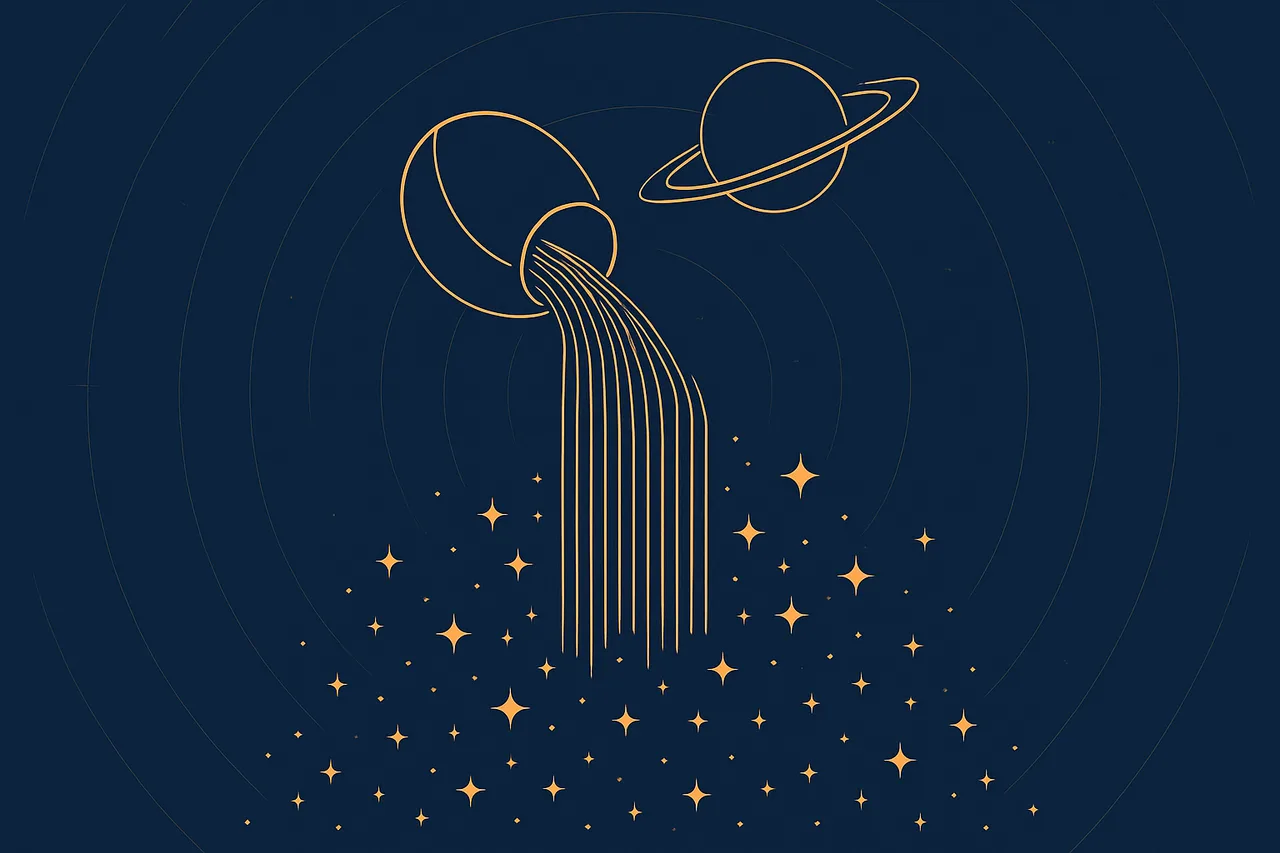
Kumbh (Kumbha) (Aquarius) · 300°–330° sidereal · rashi lord Saturn
Most sign pages tell you Aquarius is "independent and unconventional" and leave it there. That is a personality adjective, not astrology. What actually makes Kumbh Rashi behave the way it does is structural: it is Saturn's fixed, airy sign — the one where Saturn keeps his mulatrikona, the seat where he is functionally strongest short of exaltation. Capricorn is Saturn's other house, but it is his movable, earthy one. The two are not interchangeable, and almost every generic Aquarius reading treats them as if they were.
That single difference explains a great deal. An earth-sign Saturn builds things you can stand on. An air-sign Saturn builds systems, rules, networks and abstractions — structures made of agreement rather than matter. A Kumbh Moon is therefore a mind that organises, and organises at a distance: it is far more comfortable designing how a group should work than sitting inside the group feeling how it feels. That detachment is the sign's genuine strength and its recurring cost, and it comes from Saturn's element here, not from a temperament label.
One structural note worth having, because it is checkable and almost never mentioned: Aquarius holds neither an exaltation degree nor a debilitation degree. It is one of only four signs (with Gemini, Leo and Sagittarius) where no planet reaches its high point and none hits its low point. Nothing in Kumbh arrives pre-amplified or pre-damaged. Planets here are read on their own terms — which is exactly why a Kumbh chart rewards careful reading and punishes the shortcut of grading placements good or bad.
Saturn over a Kumbh Moon — and the Rahu question
Saturn rules Kumbh, and for a Moon sign that lordship is not about career or discipline in the abstract. The Moon is mind and emotional weather; Saturn is time, limit, consequence and delay. Put Saturn in charge of the mind and you get a native who processes feeling slowly and structurally: emotions are not felt and released, they are filed. A Kumbh Moon rarely reacts in the moment and then reaches a verdict months later, fully formed and difficult to appeal. This is why Kumbh natives are so often described as calm by people who know them lightly and as unreachable by people who know them well. Both are reporting the same Saturn.
Saturn here is also strong, which cuts both ways. Mulatrikona means the planet operates near full capacity, so the sign's Saturnian qualities are not diluted: endurance is genuinely high, and so is the tendency to carry things far past the point where carrying them helps. A Kumbh Moon will stay in a job, a marriage, a friendship or a grudge for years after the useful part ended, because Saturn does not experience endurance as a cost. The chart's standing question is not "can you last?" — you can — it is "is this still worth lasting through?"
Now the co-rulership, because it is real and it matters more for Kumbh than for any other sign. Parashara assigns Saturn as the sole lord of Aquarius; that is the textbook position and this page holds it. But there is a long-standing parallel tradition, carried in Jaimini-influenced and later commentarial practice and used widely in modern Indian jyotish, that Rahu acts as a co-lord or agent of Aquarius, as Ketu does for Scorpio. We flag it as a secondary tradition, not as settled doctrine — but there is a structural fact underneath it that is checkable regardless of which school you follow: Shatabhisha, one of Rahu's three nakshatras, sits entirely inside Aquarius, and it is the only one of Rahu's nakshatras that falls in a Saturn sign at all. Rahu's other two, Ardra and Swati, sit in signs of Mercury and Venus. Aquarius is the single place in the zodiac where Rahu's nature and Saturn's house occupy the same ground undivided.
What that produces in a Kumbh Moon is a genuine internal split, and naming it is more useful than any adjective. Saturn wants the rule; Rahu wants the exception. Saturn wants to serve the system; Rahu wants to hack it. Kumbh natives are the people who read the entire policy document and then find the clause that lets them ignore it — and who are honestly surprised when others experience that as disloyalty rather than as rigour. The sign is not rebellious. It is lawful in a way that keeps producing unlawful-looking outcomes.
Practically, this means Saturn's cycles land on a Kumbh Moon differently than on any other Moon sign. Saturn retrograde — from late July to mid-December in 2026 — is not a generic slowdown here; it is the ruler of your own mind turning back over ground it already covered. Kumbh natives characteristically use those months to relitigate a decision they thought was settled. And a Saturn transit over the Moon sign itself is not merely an outside pressure, as it is for a Cancer or a Leo Moon; it is the dispositor arriving at his own address. That is why the Sade Sati arithmetic below reads more sharply for Kumbh than the phrase generally does.
The transits that actually matter for a Kumbh Moon
Everything in this section is counted FROM Kumbh, which is the only way transit readings mean anything for a Moon sign. Positions were computed 7 August 2026 on the Lahiri ayanamsa. Ingress months are given as months rather than dates on purpose — the fast module used for these statements is sign-accurate rather than arc-second, and day-precise crossings belong to the full chart engine.
Start with Saturn, because for Kumbh it is the whole story. Saturn is in Meena (Pisces), which is the 2nd from Kumbh. That placement is the third and final phase of Sade Sati for this Moon sign. The full cycle ran Saturn through Makara (the 12th from Kumbh) from 2020 to early 2023, then through Kumbh itself — the peak phase, Saturn sitting directly on the Moon — from early 2023 to late March 2025, and it has been in the setting phase in Meena since. Saturn reaches Mesha around the middle of 2027, retrogrades back into Meena that autumn for a final pass, and clears the sign for good in early 2028. So the honest answer to "is Kumbh in Sade Sati right now?" is yes, and specifically in the last and mildest of its three phases, with one short return still to come. Anyone telling Kumbh natives their Sade Sati is over in 2026 is a year and a half early.
The 2nd house from the Moon is worth naming precisely, because this is where the setting phase differs from the peak. The 2nd governs accumulated resources, the family you sit at a table with, speech, and the mouth and face. Saturn transiting it does not repeat the identity pressure of the peak phase — that part genuinely is over. What it does instead is press on savings, on what you say and how carefully you say it, and on obligations owed to family. Kumbh natives typically report this stretch as less frightening and more expensive than the two years before it. That is the correct shape for this phase and it is not a warning; it is a budgeting instruction.
Then Rahu, which is the reason 2025–2026 has felt unusually loud for this sign specifically. Rahu has been transiting Kumbh itself since May 2025 and moves on to Makara in early December 2026. For a Kumbh Moon that is Rahu sitting on the Moon sign — and, if you hold the co-lordship tradition, the sign's shadow co-ruler arriving in his own quarters. Rahu on the Moon amplifies and distorts in the same gesture: appetite runs ahead of judgement, foreign or unfamiliar directions become magnetic, and things move faster than they should. Kumbh natives who made an out-of-character leap in this window were not being erratic; they were being transited. The counterpart is Ketu in Simha, the 7th from Kumbh, across the same period — detachment landing squarely on partnership. Rahu pulling the self forward while Ketu empties the other chair is the specific 2025–26 signature for this Moon sign, and it resolves when the axis shifts in December 2026.
Jupiter is the relief, with a caveat. Jupiter is exalted in Karka (Cancer) as of August 2026, which is the 6th from Kumbh. Exalted Jupiter is as strong as Jupiter gets, but the 6th from the Moon is the house of obstacles, debts, service and illness — so the strength arrives pointed at problems rather than at ease. Read plainly: this is a period where Kumbh natives can genuinely fix things — clear a debt, resolve a health issue, win a dispute, do the unglamorous repair work — and where nothing much arrives as a gift. Jupiter then moves into Simha, the 7th from Kumbh, in November 2026, taking that exalted-adjacent strength into partnership just as Ketu vacates it. For a sign whose 7th has been hollowed out since May 2025, that handover is the single most encouraging dated change on this list.
Timing and remedial practice for Kumbh
The weekday is Saturday — Shanivar — because Saturn rules the sign, which Kumbh shares with Makara. The sharper instrument is the hora rather than the day: the first hora after sunrise on Saturday belongs to Saturn, and in the Chaldean order his hora returns every seventh hour after that. Kumbh natives who want a Saturn-aligned window for something structural — signing, committing, beginning a long obligation, having a difficult and necessary conversation — get more out of a correctly chosen Saturn hora than out of treating a whole Saturday as auspicious. It is not, and Saturday as a blanket "good day for Aquarius" is one of the lazier claims on the internet.
For deity association, Kumbh gives you two anchors rather than one, and the second is the sign-specific one. Shani Dev is the graha devata of the lord, and the widespread North Indian Saturday practice of reciting the Hanuman Chalisa for relief from Saturn's pressure sits alongside it — we name that as devotional tradition, which is what it is, not as a mechanism. The distinctly Kumbh anchor is Varuna, the presiding deity of Shatabhisha, the nakshatra that occupies the middle of this sign and no other. Varuna governs cosmic order, oaths, waters and the binding of what is owed — which is a strikingly exact fit for a Saturn-in-the-2nd year, where speech, promises and debts are the live material. Water offerings and vows kept precisely are the traditional Varuna practice, and for a Kumbh native in the setting phase of Sade Sati they are more to the point than a generic Saturn remedy.
On gemstones we will be blunt, because this is where Kumbh gets bad advice most often. Blue sapphire is routinely recommended to Aquarius natives on the reasoning that Saturn is the lord. For a Kumbh ascendant that logic holds — Saturn is a functional benefic there. But Kumbh as a Moon sign is not the same question, and the functional grading that decides gemstone safety is reckoned from the ascendant, not the Moon. Two things follow. If Kumbh is also your rising sign, note that Venus is the yogakaraka for this lagna — ruling both the 4th (Taurus) and the 9th (Libra) — and that Jupiter, the planet everyone assumes is universally benign, is a functional malefic for Aquarius rising. A yellow sapphire prescribed to an Aquarius ascendant on general principle is a genuine mistake. And if you only know your Moon sign, no honest astrologer can grade your gemstones at all, because the grading needs a birth time. We would rather say that than sell you a stone.
Who owns your twelve houses — and why Kumbh’s lord also owns the house of loss
The layer under the transits: which graha is permanently answerable for each department, regardless of what is passing through.
Saturn owns Kumbha and Makara, and from Kumbha, Makara is the 12th. So the graha that defines this sign also governs expenditure, dissolution, sleep, foreign ground and everything spent without an obvious return. No other rashi is arranged that way — Makar has Saturn on the 1st and the 2nd, which puts the same planet on accumulation; Kumbh gets him on release. It is the cleanest structural account of why this Moon sign is so consistently described as detached: the planet running your mind is simultaneously running the department of letting go, and the two cannot be separated by any transit or any remedy. What looks like indifference from outside is one graha holding both ends of the same rope.
The 6th here belongs to the Moon. Karka is the 6th from Kumbha, and the Moon owns Karka alone, so your house of illness, debt, service and opposition answers to the fastest and most changeable of the seven — Meena is the only other rashi with a single-sign luminary on the 6th, using the Sun. For a Kumbh Moon it means conflict and health are tidal rather than structural: they arrive in cycles, they crest, they recede, and treating them as permanent conditions misreads the owner. Mercury takes your 5th and 8th, so creative output and the hidden share a lord. Jupiter takes the 2nd and the 11th — both money houses, one planet. Mars takes the 3rd and 10th, Venus the 4th and 9th.
Held against the sky computed for this page, the pairing that matters is Jupiter’s. On 7 August 2026 Jupiter was exalted at 13°49′ Karka, in your 6th, while owning your 2nd and your 11th — your two money houses, both governed by a benefic at its ceiling, standing in the house of debt and service. Saturn, owner of your 1st and 12th, was retrograde at 20°07′ in your 2nd. Rahu sat on your Moon sign itself at 6°22′. And the 3rd, 9th, 10th, 11th and 12th carried nothing slow whatsoever.
Kumbh, Aquarius, and why your Sun sign may not match
Kumbh (also written Kumbha) is Aquarius. The Sanskrit means "the pot" or "water vessel", which is the sign's symbol — the vessel that carries and distributes, not the water itself. That image is a better summary of the sign than the English adjectives usually attached to it: Kumbh is the mechanism by which something reaches many people, and it is characteristically more attached to the distribution than to the contents.
The dates are where confusion starts, so here they are separately. Vedic astrology uses the sidereal zodiac with the Lahiri ayanamsa, so the Sun occupies sidereal Aquarius roughly from 13 February to 14 March. Western astrology uses the tropical zodiac, where Aquarius runs roughly 20 January to 18 February. The gap is about 24 days, and it is not an error in either system — it is the accumulated precession of the equinoxes, which the sidereal zodiac tracks and the tropical one does not. This is why a great many people who have called themselves Aquarius their whole lives compute as Capricorn in a Vedic chart, and why people born in early March discover they are sidereal Aquarius having never once been told so.
And then the more important distinction, which the dates above have nothing to do with. "Kumbh Rashi" in Indian practice almost always means your MOON sign — where the Moon was at your birth — not your Sun sign. Everything on this page is written for the Moon sign, because that is what Indian rashifal means by rashi and it is what the transit arithmetic above is counted from. The Moon changes sign roughly every two and a quarter days, so there is no date range that can give you your Moon sign; it needs your actual birth date, and ideally the time. If you arrived here knowing only that you are "an Aquarius" from a Western horoscope, the honest position is that you may or may not be Kumbh Rashi, and a chart is the only way to find out. We would rather send you to compute it than let you read a page written for someone else's Moon.
The nakshatras of Kumbh — all nine padas
Kumbh spans exactly nine padas of 3°20' each. Two belong to Dhanishta, four to Shatabhisha, three to Purva Bhadrapada. The navamsa column follows the classical rule for a fixed sign: the nine navamsas of Kumbh begin from the 9th sign, Tula. Where your Moon falls in this table changes the reading considerably — the same Kumbh Moon under Dhanishta 3 (Mars, Vasus, drum) and under Purva Bhadrapada 2 (Jupiter, Aja Ekapada, sword) are not the same person.
| Nakshatra & pada | Sidereal span | Nakshatra lord | Navamsa sign | What it shifts |
|---|---|---|---|---|
| Dhanishta pada 3 | 300°00′–303°20′ | Mars | Tula (Venus) | Rhythm and timing applied to people. Mars gives the Kumbh detachment a working pulse — this pada performs, organises events, and reads a room's tempo. The Venus navamsa softens Mars considerably; the risk is charm doing work that honesty should. |
| Dhanishta pada 4 | 303°20′–306°40′ | Mars | Vrishchika (Mars) | Mars in his own navamsa under a Mars nakshatra: the most forceful ground in the entire sign. Wealth-building drive and real competitive heat sit oddly on a Saturn-cooled Moon, and this pada is where Kumbh natives are most likely to surprise people with sudden intensity. |
| Shatabhisha pada 1 | 306°40′–310°00′ | Rahu | Dhanu (Jupiter) | The "hundred healers" open under Varuna, with Jupiter's navamsa giving the only genuinely philosophical stretch of the sign. Healing, research and diagnosis with a moral frame. Reclusiveness begins here and deepens across the next three padas. |
| Shatabhisha pada 2 | 310°00′–313°20′ | Rahu | Makara (Saturn) | Rahu's nakshatra in Saturn's navamsa inside Saturn's sign — the most heavily Saturnian ground in Kumbh. Endurance and secrecy both peak. Excellent for long technical mastery; the hardest pada for asking anyone for help. |
| Shatabhisha pada 3 | 313°20′–316°40′ | Rahu | Kumbh (Saturn) | Vargottama-adjacent in effect: the navamsa repeats the rashi, so the sign's own character is doubled rather than modified. The purest expression of Kumbh in the zodiac — systems thinking, distance, and Shatabhisha's empty-circle symbolism of the boundary that encloses without touching. |
| Shatabhisha pada 4 | 316°40′–320°00′ | Rahu | Meena (Jupiter) | Shatabhisha's closing pada dissolves into Jupiter's water navamsa. The healer's detachment finally admits feeling. Mystical, medical or addiction-adjacent themes cluster here; the boundary Shatabhisha guards elsewhere becomes porous. |
| Purva Bhadrapada pada 1 | 320°00′–323°20′ | Jupiter | Mesha (Mars) | Aja Ekapada, the one-footed goat, under a Mars navamsa: the sign's ignition point. Intense, principled, confrontational. This pada argues with institutions rather than routing around them, which is atypical for Kumbh and often costly. |
| Purva Bhadrapada pada 2 | 323°20′–326°40′ | Jupiter | Vrishabha (Venus) | The sword nakshatra in Venus's earth navamsa — intensity given something material to hold. Money, resources and voice become the arena. The most financially grounded pada in an otherwise abstract sign. |
| Purva Bhadrapada pada 3 | 326°40′–330°00′ | Jupiter | Mithuna (Mercury) | The last pada of Kumbh, in a Mercury navamsa: the two-faced-man symbolism of Purva Bhadrapada meets Gemini duality. Articulate, persuasive, capable of holding two irreconcilable positions with total sincerity. The sign's exit is its most verbal ground. |
Rulers, deities and symbols verified against the nakshatra reference used across AskSoma. Nine padas × 3°20′ = 30°, which is the arithmetic check that this table is complete.
Where today's sky lands for a Kumbh (Kumbha) Moon
- Work
- Saturn mulatrikona in Kumbh; exalted Jupiter in the 6th from the Moon
- Kumbh works best where the output is a system rather than a performance — networks, platforms, technical standards, large organisations, anything where the thing you built keeps working after you leave the room. Saturn at mulatrikona strength here means the capacity for sustained unglamorous work is genuinely above average, and Kumbh natives underrate it because it never feels like effort. Through 2026 the workplace signal is exalted Jupiter in the 6th from your Moon: strength aimed at obstacles. This is a year for fixing what is broken, winning the dispute, cleaning up the process, absorbing the difficult colleague's work — real progress that will not look like promotion. Kumbh natives who measure this period by recognition will conclude wrongly that nothing happened.
- Money
- Saturn transiting Meena — the 2nd house from Kumbh
- This is the most specific financial statement on this page, and it applies to Kumbh and to no other Moon sign right now. The 2nd from the Moon is the house of accumulated wealth, and Saturn is sitting in it — that is precisely what the setting phase of Kumbh's Sade Sati consists of. Expect resources to feel constricted rather than absent: money arrives, it just arrives committed. Recurring obligations, family expenses and long-deferred costs are the characteristic shape. Saturn does not destroy the 2nd house, he audits it, and the natives who come out of this phase best are the ones who let the audit happen — cancel what is not used, renegotiate what is overpriced, and refuse new fixed commitments until Saturn clears Meena for good in early 2028. Aggressive expansion of fixed costs during this window is the one avoidable mistake.
- Relationships
- Ketu in Simha — the 7th from Kumbh — with Jupiter entering the same house
- Since May 2025 Ketu has been in the 7th from Kumbh, and Ketu in the partnership house does not create conflict; it creates absence of appetite. Kumbh natives in this window have typically found relationships going quiet rather than going wrong, and — because Saturn already inclines this Moon toward distance — have often not noticed how far they had withdrawn until someone told them. Naming it matters more than fixing it: the detachment is transiting, not characterological. Jupiter enters that same 7th house in November 2026 as Ketu leaves in December, which is a genuine and datable turn. For a sign that has been running its partnerships on low power for eighteen months, that is the change worth waiting for, and it rewards Kumbh natives who have kept the relationship intact rather than concluded it was over.
- Health
- Kumbh as Saturn's air sign (vayu tattva); Aquarius rules calves and ankles in the Kalapurusha
- Kumbh carries a double vata signature that Makara does not, and this is the clearest place the two Saturn signs must be read differently. Saturn is the vata graha and Kumbh is his air sign, so the constitutional tendency here is dryness, wind and nervous-system load rather than the earthy heaviness of Capricorn. In practice that means sleep, circulation, joints and anxiety are the standing vulnerabilities — and in the Kalapurusha scheme Aquarius governs the calves and ankles specifically, which is where circulatory and joint complaints tend to present for this sign. The vata-pacifying direction is unfashionably simple: warmth, oil, regularity, and enough sleep. With Saturn currently in the 2nd from the Moon — the house of the mouth — eating habits and teeth are the live area in this particular window. None of this is a diagnosis, and a Kumbh Moon with a real symptom needs a doctor, not an astrologer.
Kumbh (Kumbha) rashifal — frequently asked
Is Kumbh Rashi in Sade Sati right now?
Yes — in the third and final phase. Sade Sati runs while Saturn transits the 12th, 1st and 2nd from your Moon sign. For Kumbh that was Makara from 2020 to early 2023, Kumbh itself from early 2023 to late March 2025 (the peak), and Meena since. Saturn reaches Mesha around mid-2027, retrogrades back into Meena that autumn for a final pass, and leaves for good in early 2028. So the cycle is genuinely easing, but it is not over in 2026, and this last phase presses on money, speech and family rather than on identity.
What is the difference between Kumbh Rashi and Aquarius sun sign?
Two differences, stacked. First, Kumbh Rashi almost always means your MOON sign in Indian practice, while a Western "Aquarius" is your Sun sign — different planet, different meaning. Second, Vedic astrology uses the sidereal zodiac (Lahiri), where the Sun is in Aquarius roughly 13 February to 14 March; Western astrology uses the tropical zodiac, roughly 20 January to 18 February. The ~24-day gap is precession, not an error. Plenty of lifelong Western Aquarians compute as Makara in a Vedic chart, and the only way to know your actual Moon sign is to compute it — the Moon changes sign every two and a quarter days, so no date range exists for it.
Why is Rahu significant for Kumbh specifically?
Two reasons. Practically, Rahu has been transiting Kumbh itself since May 2025 and moves to Makara in early December 2026 — for a Kumbh Moon that is Rahu sitting directly on your Moon sign, which amplifies appetite and accelerates decisions. Traditionally, there is a long-standing school (Jaimini-influenced, widely used in modern India) that treats Rahu as a co-lord of Aquarius, as Ketu is for Scorpio. That is a secondary tradition, not the Parashari position. What is not in dispute: Shatabhisha, one of Rahu's three nakshatras, sits entirely within Aquarius, and it is the only Rahu nakshatra that falls in a Saturn sign at all.
Which nakshatras fall in Kumbh Rashi?
Three, though only one of them lies wholly inside the sign. Dhanishta contributes its 3rd and 4th padas (300°00′–306°40′, lord Mars). Shatabhisha contributes all four padas (306°40′–320°00′, lord Rahu) — the only complete nakshatra in Kumbh. Purva Bhadrapada contributes its first three padas (320°00′–330°00′, lord Jupiter), with its fourth crossing into Meena. Nine padas of 3°20′ each, totalling the sign's 30°.
Should Kumbh natives wear a blue sapphire?
Not on the basis of this page, and not on the basis of any sign page. Blue sapphire is Saturn's stone and Saturn rules Kumbh, which is where the recommendation comes from — but gemstone safety is decided by a planet's FUNCTIONAL nature, which is reckoned from your ascendant, not your Moon sign. If Kumbh is also your rising sign, Saturn is a functional benefic there and Venus is the yogakaraka; notably Jupiter is a functional malefic for Aquarius rising, which is the opposite of what most people assume. If you only know your Moon sign, the grading cannot be done. Blue sapphire is the most reactive stone in the set, and prescribing it from a Moon sign alone is not something we will do.
What this page can NOT tell you
- A Moon sign covers one-twelfth of everyone alive — roughly 700 million people share Kumbh Rashi with you. Everything on this page is true of that entire group, which is exactly why none of it is specific to you. The transits above are real and correctly counted from Kumbh; what they will actually produce depends on which house Meena and Simha occupy in YOUR chart, which planets you have there natally, and which Mahadasha you are running. A Kumbh Moon in a Vimshottari Venus period and a Kumbh Moon in a Saturn period will experience the same Sade Sati phase as different years.
- This page cannot tell you which of the nine padas your Moon occupies, and that changes the reading substantially — Dhanishta 4 and Purva Bhadrapada 3 sit at opposite ends of the same sign with different lords, different navamsas and different temperaments. Finding your pada needs your birth date and a computed chart, not a date range.
- Sade Sati is a transit of the 12th, 1st and 2nd from the Moon. It is not a curse, a sentence, or seven and a half years of misfortune, and the three phases genuinely differ — Kumbh natives are in the mildest of them right now. Anyone selling you a remedy priced on fear of Sade Sati is selling fear, not astrology.
- Timing lives in the Dasha, not on a sign page. Transits describe the weather; the Vimshottari Mahadasha and Antardasha describe whose season it is. When a Kumbh native asks "when will this lift?", the honest answer needs a birth time, and this page does not have one.
- The functional-benefic grading referenced above — Venus as yogakaraka, Jupiter as a functional malefic — is reckoned from the ASCENDANT, not the Moon. It applies to you only if Kumbh is also your rising sign, which needs an accurate birth time to establish. We would rather flag that boundary than let you act on a gemstone recommendation that was never yours.
- One genuine uncertainty we will not paper over: the Rahu co-lordship of Aquarius is a real and widely-used tradition, but it is not the Parashari position, and schools disagree. We have marked it as secondary throughout. The structural fact underneath it — that Shatabhisha is the only Rahu nakshatra in a Saturn sign — holds regardless of which school you follow.
Sign placements, nakshatra padas and transit positions on this page are computed sidereally with the Lahiri ayanamsa — the same engine that runs every chart on AskSoma. Transit statements were computed on 7 August 2026 and ingress moments are stated at month resolution, because that is the honest precision for durable page copy; the live panel on this page quotes the arc-second engine directly. Classical claims (Saturn's mulatrikona in Aquarius, the navamsa rule for fixed signs, nakshatra lords and deities) are Parashari-standard and marked where a secondary tradition is involved.
How AskSoma computes and what we refuse to claim · Engine: Swiss Ephemeris · Ayanamsa: Lahiri (Chitrapaksha) · Content reviewed 2026-08-07 · Transit positions computed for 2026-08-07
What people rate AskSoma
4.8/5 from 100+ reviews on the selected public wall; 4.5/5 on Trustpilot from 16 reviews; 9.6/10 average across 286 selected satisfaction responses. Figures as of 2026-06-25. Satisfaction is not Net Promoter Score.
About the author
Written by Savan Vyas, founder of AskSoma.
The astrology is not written from memory: every chart position, dasha period and panchang timing AskSoma shows is computed with the Swiss Ephemeris on the Lahiri (Chitrapaksha) ayanamsa. How we calculate.